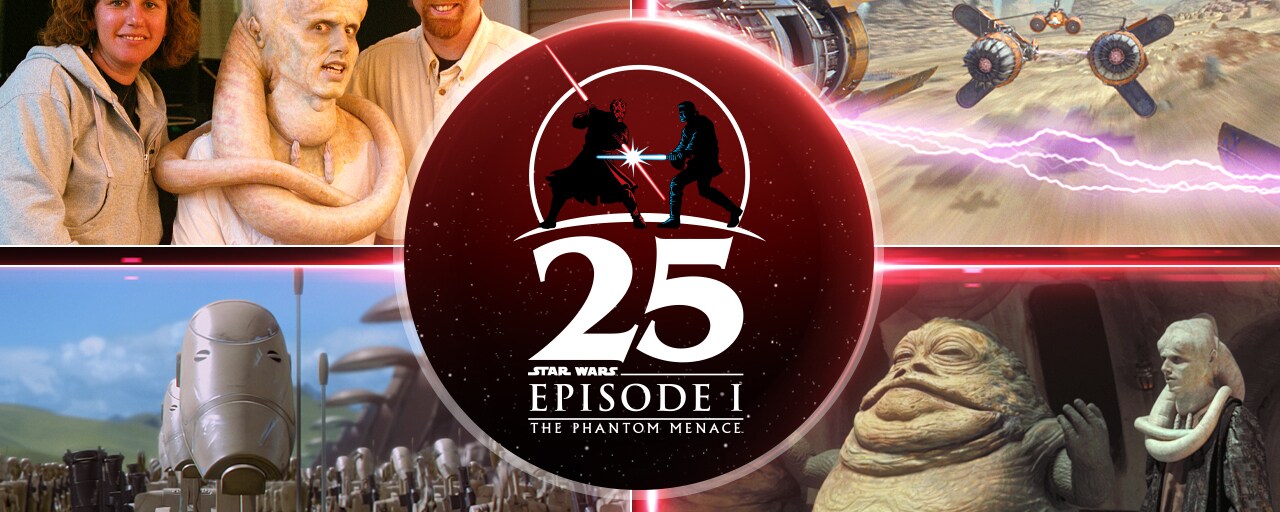
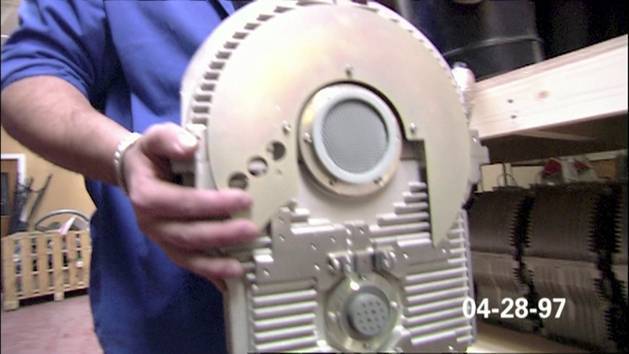
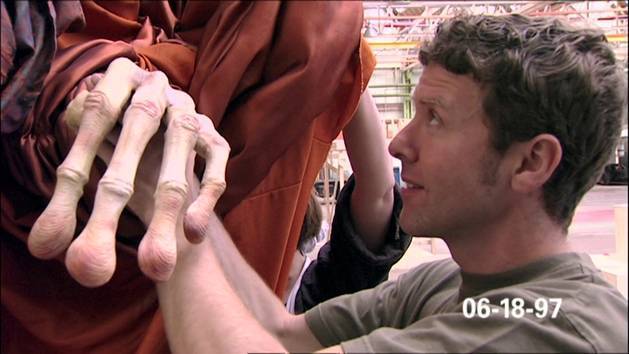
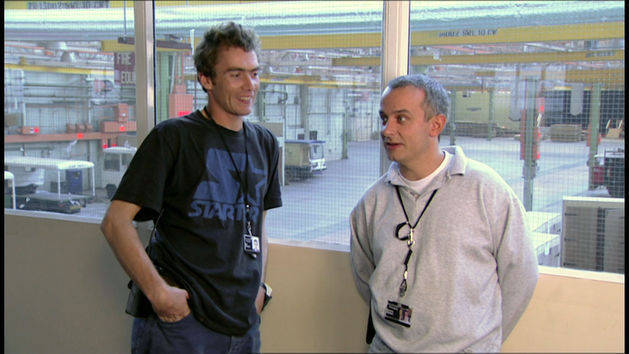
The animatronics department is one of the most interesting places at Leavesden, littered with batteries and lights and springs and wires, and skulls and teeth and ears and eyebrows. It's not hard to imagine that these people could build a real, fully functioning droid. There are remote control units everywhere, and along with the blaring music (which the mechies seem to require to be able to work) there is the omnipresent whirring sound of tiny motors being put through their paces.
Everything here is wonderfully tactile. There are no lines of code being written here, no smooth computer rendering... just real sculpting and real wiring. Beneath the silicon masks of the creatures are metal muscles and tendons capable of an extraordinary display of articulation. Some characters are literally capable of lip-syncing human speech.
In the shop the mechies are all hunched over their creations, further fine-tuning the movements. The artists take great pride in finding the most elegant way to solve the problems of facial motion, each striving after the "Sexiest Mech of the Week" award for the most impressive innovation. One week the award may be for a brow-furrowing mechanism, the next week for an eye-rolling device.
With the exception of the batteries and stock parts like the nuts and bolts, everything is handmade here, and each mechanism reflects a particular mechy's style. Unless certain creatures have to be mass produced, each mechy will approach the problems in their own way -- meaning each person has his or her own technique for mouth movements, eye blinking, and so on. Thus, if only two creatures of a particular alien species have to be made by two different mechies, their resemblance is literally only skin deep - below the surface there are likely to be two completely different mechanisms producing the same result.
Each mechy is able to control his mask with great dexterity. They usually work with the actor underneath the mask to try to lip-sync the dialogue. This means that with their remote control units they must keep up with the actor's speech and reproduce the proper mouth movements on the fly, via their remote control units. They are therefore remarkably fast and agile with their buttons and joysticks.
Some of the masks are extremely complex, and require not only the movement of the actor wearing the mask but also several remote control units, and soon one creature's speech and facial expressions become a complex three-man job, where all three need to be in perfect sync with each other. When done right (which it almost always is, of course), the effect is stunningly life-like.
Mechy work attracts people from a surprising variety of backgrounds, from horticulture to graphic design. In spite of the resulting individuality of mechy work, however, there are a few principles that unify their work. One trait they all seem to have in common is a knack for finding simple, elegant solutions to complex problems. All the different kinds of circuitry and wirework the mechies devise is alike in that it is clean. There is nothing superfluous. The masks are made to be as simple and lightweight as possible, and most of the motor and battery work is in fact worn on the back, with just the wirework extending into the mask. This way the mask can conform to any shape, without having to make room for motors. The range of solutions and problem-solving approaches amongst the mechies is as remarkable as the illusions of life they help to create.
Animatronics creatures like Yoda will continue to hold an important place in filmmaking even as computer graphics become increasingly sophisticated. The mechies pour themselves and their personalities into their work, infusing personal, hand-held nuances to their projects. These subtleties and this physical, human touch help transform creatures into believable characters, making them -- and the story -- come alive for the audience.