
In 1977, when audiences throughout North America sat down in darkened theaters to watch
Star Wars for the first time, these ten words, in tall blue letters, flashed on the screen as the very first shot of the movie. There are many different ways to open the front door of a film and invite moviegoers to step inside: introductory words from a narrator, a long shot of a landscape that sets up both the location and the tone of the story that is about to be told, or two characters interacting in a way that reveals their personalities and the relationship that binds them together. For
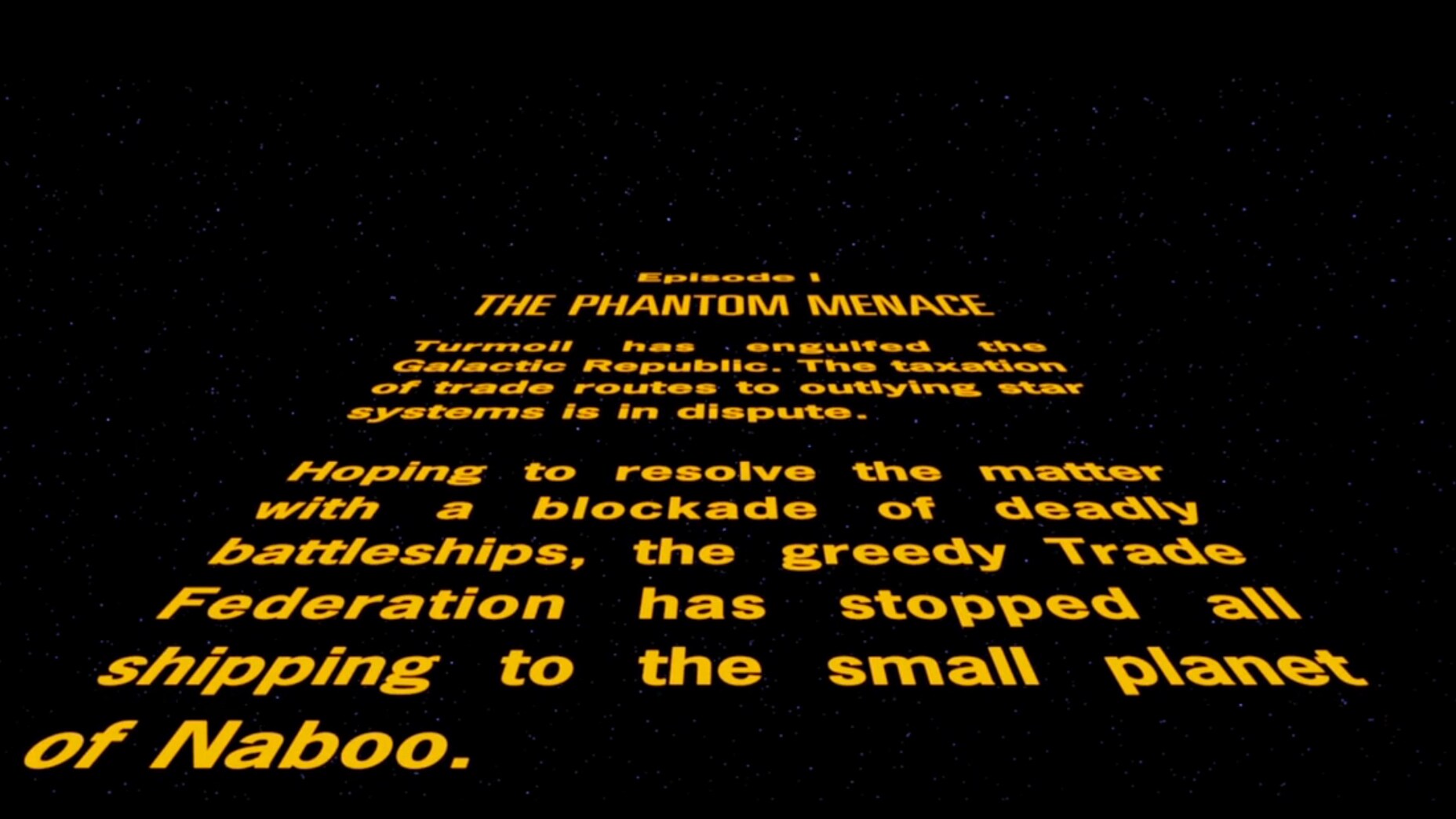
Star Wars, George Lucas had chosen to make use of printed text: first some titles and then a few concise paragraphs, scrolling upward against a star field. To Lucas it was the best way to draw the audience in and begin to tell his story in medias res, bypassing the standard movie exposition by the use of a medium that, since the advent of the talking picture, usually belongs outside the sphere of cinema.
Lucas' technique worked very well, drawing the audience right into the action, and he used it again to introduce the two subsequent Star Wars movies, The Empire Strikes Back and Return of the Jedi. Each time, the only variable that changed was the text itself - every other detail remained untouched, as if the audience were simply flipping through the pages of a book, reading one chapter after the other, moving forward along one continuous storyline.
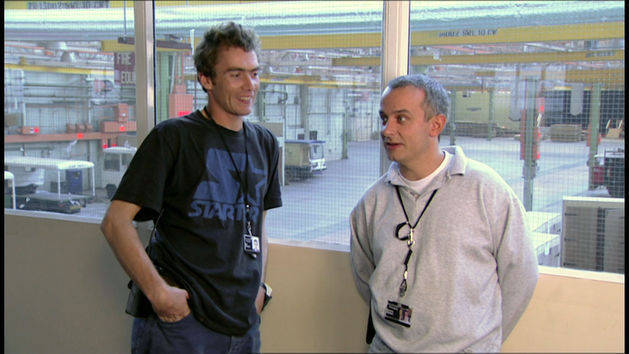
This consistency was important to help maintain a sense of continuity throughout the saga - and it still holds true sixteen years after the classic trilogy came to a conclusion. During post-production on the new chapter of the story, Episode I, Visual Effects Supervisor John Knoll needed to make sure that the traditional roll-up looked exactly like it did in its previous incarnations. Once again, those words would be the first sight caught by moviegoers when Episode I opened on May 19th, 1999, and the overture of chapter 1 would naturally be expected to look no different than the other chapters of the big storybook.
"For the classic trilogy," explains Knoll, "a high contrast film of the text was laid out flat on a long lightbox (a transparent table lit from underneath), with a camera set up on rails running parallel to the lightbox. The camera was controlled by a computer to make sure the scrolling speed remained constant: that's what we call a 'motion-control camera'. To create the illusion of text disappearing on the horizon, the special effects guys tilted the camera at an angle and ran it down the track. A star field was later optically added to complete the footage." This effective procedure was used to create the opening of all three classic movies.