Lynne's Diaries -- Part 6: Prime of the Jedi

Email Archives
November 30, 1998

By Lynne Hale

The lightsaber battles of Star Wars: Episode I are more than spectacle. As glowing blades flash and Jedi fighters combat the dark side of the Force, their each and every move is the result of careful planning by real-life Jedi Master Nick Gillard, Stunt Coordinator for Episode I. Much more than pure action, the lightsaber battles of this film are designed to advance the story and reveal the nature of the characters through physical movements in combat.
Nick's goal in choreographing the action for Episode I was to create stunts that flow from the story. "You can't just think, 'I'm a stunt coordinator, I'm going to make a big stunt happen'," he says. "It's all about making it tie in nicely with the film so that you don't notice the stunts." Creating narrative through physical expression, Nick wrote each fight as an individual story that supports the overall structure of the movie. "All the fights have a beginning, a middle and an end," he says. "I worked hard to write them like a story."

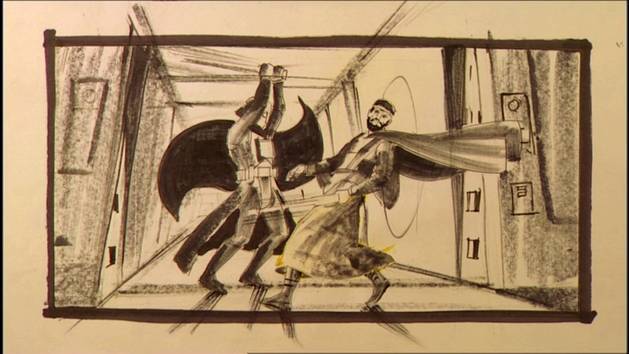
To create fight choreography that would demonstrate not just Jedi swordsmanship but also the individual characters of the fighters, Nick studied the Episode I script and storyboards carefully. No two sword masters have exactly the same style, and Nick has woven the subtleties of distinct identities into the choreography of the lightsaber battles. "It was important to me that each character in Episode I have a distinctive fighting style," he says. Some of this shading came from the classic Star Wars Trilogy. For Obi-Wan, he took into account the lightsaber fighting style used in the original trilogy because Obi-Wan Kenobi trained both Anakin and Luke Skywalker. Some of their methods should be reflected in the style we see Kenobi use as a younger man, he says.

To keep them alive in the dangerous world of Episode I, Nick had to give his Jedi Knights a unique and powerful style of fighting. "I call it 'Jedi Style'," he says. He explains that having chosen such a short-range weapon to use against blasters, the Jedi would have to be well skilled in all manners of fighting and defending themselves. Combining a variety of disciplines from various fencing styles to martial arts "with a touch of tennis and tree chopping," he created the distinctive 'Jedi Style' seen in the Episode I lightsaber battles. Each fighter's moves are 'for real' rather than for cinematic flourish, and the battles demonstrate the fighting prowess of trained experts. "I wrote them very much like a game of chess played at a thousand miles an hour. And every single move is check," he says.

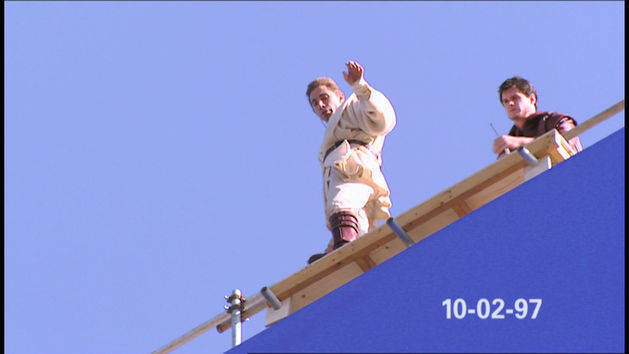
Nick wasn't sure whether his intense approach was what director George Lucas would want for Episode I. So, he shot a test fight with his team of stunt doubles to demonstrate this approach about three months before shooting began. George liked what he saw, and so the "Jedi Style" lightsaber school began in earnest.

When safety permits, Nick likes for actors to do their own stunts. "It adds to their performance," he says. He didn't have a lot of time to train Episode I stars Liam Neeson and Ewan McGregor in the art of Jedi Style, but says they both picked up the moves very quickly. He would break the fights up into small sections, and teach them segment by segment, slowly increasing the pace as the actors learned their parts.

With his assistant Andreas Petrides and martial arts expert Ray Park, Nick would practice the fight scenes and stunts for hours on end so they could train the actors quickly. "By the time we got to Liam and Ewan, we had run through the choreography at least 500 times ourselves," he says. "We've hit each other so many times, we know where it's going to happen."

The lightsaber battles end up very fast on film. "It's probably so fast that you'll hardly be able to see the little touches we put in," Nick says. But he still feels that all the effort was worth it. "It's Star Wars," he says. "We had to do something special."


Keywords: Behind-the-Scenes, Stunts, Production Diary

Filed under: The Movies, Episode I, Video

Databank: lightsaber
Email Archives
 (
0 ratings
)

Comments: 0 total     See All

Celebrate 10 Years of The Phantom Menace
On May 19, 1999 the Star Wars saga began anew....
Celebration Soundbites: Nick Dudman Part II: Q&A
Our Celebration I panel audio continues with an audience Q&A with Star Wars creature effects supervisor Nick Dudman
A Look Back at Star Wars Celebration
Splish Splash, the Star Wars Celebration was a Smash! Fans from all corners of the globe descended on Denver, Colorado April 30-May 2, 1999, for the grand three-day event.
Celebration Soundbites: Nick Dudman
Listen in on the goings-on in Hall A of 1999's Celebration I in this first of a four-part audio series commemorating the fan event's tenth anniversary.
Snapshot: Shelved Creature Heads
Shelved creature heads in the Creature Effects Department at Leavesden Studios.
Q&A: What kind of new technologies were developed to realize Episode I?
Many visual effects techniques for The Phantom Menace had never been attempted before. How much new technology and software needed to be developed to carry out what was required. Who does that kind of work and how long does it take?
Snapshot: John Fensom
Malcolm Evans (Left, Animatronic Model Designer) and Vicky Winning (Art Finisher) outfit John Fensom (Designer Creatures Assistant) in a protocol droid costume in preparation for a stills shoot in the Stills Studio at Leavesden Studios.
Snapshot: Idle Landspeeder
An idle landspeeder rests on the Mos Espa main street set, on location near Tozeur, Tunisia.
Snapshot: Horox Ryyder
A close up of the fully painted head piece from the Horox Ryyder costume, in the Creature Effects Department at Leavesden Studios.
Snapshot: A Sea of Bluescreen
Qui-Gon Jinn (Liam Neeson) sits amid a sea of bluescreen. Industrial Light & Magic magicians will later digitally add a lumbering eopie and background to complete the scene.
Newsletter sign up!
Enter your email here and receive exclusive Star Wars updates