![[ Shades of Blue and Red ]](/episode-i/bts/design/f20000313/img/guardwalk_sm.jpg)
Their crimson hues stand out from the stark gray and black of the Imperial color palette. Their silent and foreboding presence heralds the arrival of the galaxy's most evil presence. They are the
Emperor's Royal Guard, among the deadliest warriors in
the Empire.
The roots of the Royal Guard's design are hinted at during the Coruscant sequences of Episode I The Phantom Menace. Escorting Chancellor Valorum as he meets Queen Amidala is a retinue of Senate Guards, dressed in deep royal blue robes and armor.
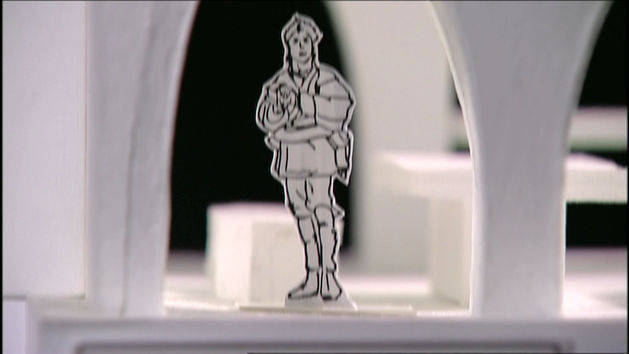
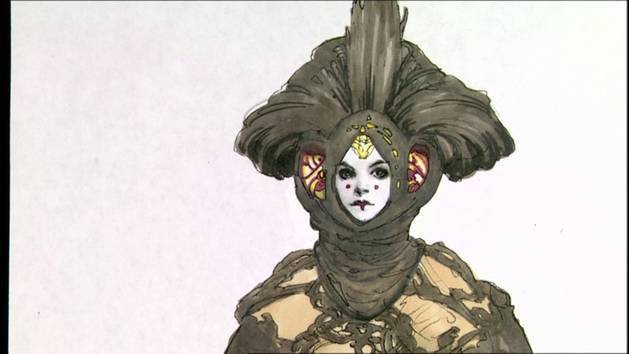
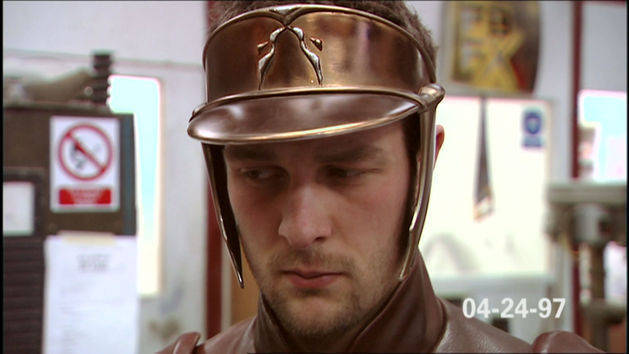
"What I'm doing is taking the Imperial Guard's mask from the original films and modifying it for use in this film by cutting the face out of it," explains conceptual artist Jay Shuster as he sketches out the design of the new Senate Guard. "We're going to use the same molds, actually, from the original model to streamline that process."
In addition to cutting away the visor -- the Senate Guard is considerably less menacing with a human face attached to it -- a double-crest of dark blue plumage provides a visual cue to an older, more traditional era.
In the Star Wars galaxy, the blue robes of the Senate Guard symbolize the Senate's supreme authority in the long tradition of its wise and just rule. They are armed with large, unwieldy ceremonial rifles -- indicative of a placid past, since more militaristic times would require more efficient weaponry.
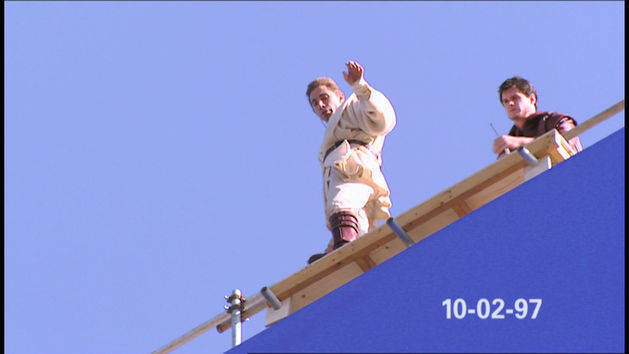
The blue robes are also a subtle indication of considerable advancement in special effects. In the time of the classic trilogy's production, blue wardrobe was forbidden for bluescreen filming. The bluescreen process would result in areas of that color to read "transparent" -- that is, anything blue would be replaced by the background image. Now, digital compositing allows an entirely cerulean-clad guard to stand before a bluescreen.
"The digital advancements allow us to select specific hues and tones of blue to isolate the screen from even actors dressed in other types of blue," says visual effects supervisor Scott Squires , "It is certainly easier and more controllable." Squires' team handled the arrival of Chancellor Palpatine and his Senate Guards onto Naboo. The scene was shot against bluescreen cloth with both Palpatine and his guards wearing blue.
The evolution from the Senate Guard to the Royal Guard is strongly implied, but the actual transition as a part of Palpatine's rule has yet to be revealed. There are notable hints, though, such as Palpatine's preference for the color red as seen in the blood-red décor of his apartment quarters on Coruscant.
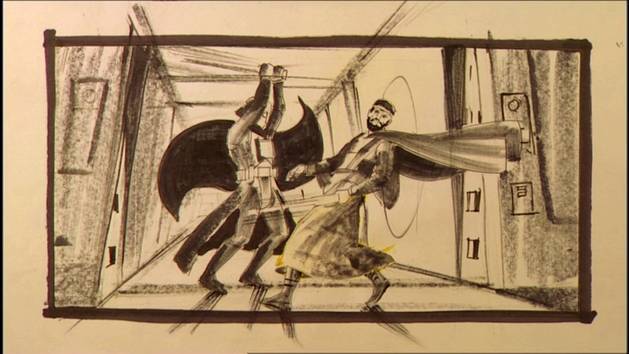
The design of the Imperial Royal Guard came from sketches by Nilo Rodis-Jamero. These varied from centurion-like warriors to priest-like monks, but a common thread tying the designs together was the crimson hue.
A sketch dated September 11, 1981 came close to locking the design of the Royal Guardsman. Interestingly enough, some of the rejected concepts took a life of their own, and would return in the Expanded Universe of comic books and toys.
Late in the original action figure toy line, the Kenner art department experimented with continuing the Star Wars saga beyond Return of the Jedi through action figures. One of their concepts involved a villain named Atha Prime, the Clone Master. Atha Prime's design was based on a rejected sketch for the Royal Guard. Although this initial Expanded Universe idea was rejected, Atha Prime would make it as an action figure almost a decade later.
When Tom Veitch and Cam Kennedy populated the panels of their Dark Empire comic series, one of their creations was the Imperial Sentinel. Hulking, silent brutes, the sentinels are said to be the twisted creation of the resurrected Emperor's clone masters. Others believe them to be alien giants, while still others speculate they may be hideous cyborgs underneath their voluminous robes.
Whatever the truth beneath the armor, the Imperial Sentinel's design heritage can be readily seen. The Sentinels were inspired by the same design sketch as Atha Prime, and years later, when Hasbro would release action figures inspired by the Expanded Universe, the Imperial Sentinel was part of the line-up.
The Royal Guards are the most highly trained Imperial warriors. Experts in the martial art of echani, they practice in a place called the Squall on the barren world of Yinchorr. As part of a test of their loyalty, a Guardsman must duel to the death with his training partner. Once victorious, the Guardsman can don the flowing red robes, concealing the sleek armor underneath.
The Crimson Empire comic series pulled back several veils of mystery that shrouded the order of the Royal Guard. In the Dark Horse comic series written by Mike Richardson and Randy Stradley, and illustrated by Paul Gulacy and Randy Emberlin, we learn of treachery within the crimson ranks. A Royal Guard named Carnor Jax seizes power of the increasingly fragmented Empire by betraying his fellow guardsman. Another surviving Royal Guard, Kir Kanos -- whose loyalty is to Palpatine's memory -- makes it his mission to hunt down Jax for treason.
Like many of the peripheral elements of the Star Wars saga, it was the Royal Guard's physical appearance that contributed to its appeal, since on-screen, they didn't really do much other than stand there. "We just thought the costumes those guys had were so cool and so compelling that we wanted to see them do something," says Stradley.
The Crimson Empire series has spawned two sequels: Crimson Empire II: Council of Blood and the upcoming (and as yet unsubtitled) Crimson Empire III. This new series is being previewed in an exclusive four-part serial in the pages of Dark Horse Extra #21-24.