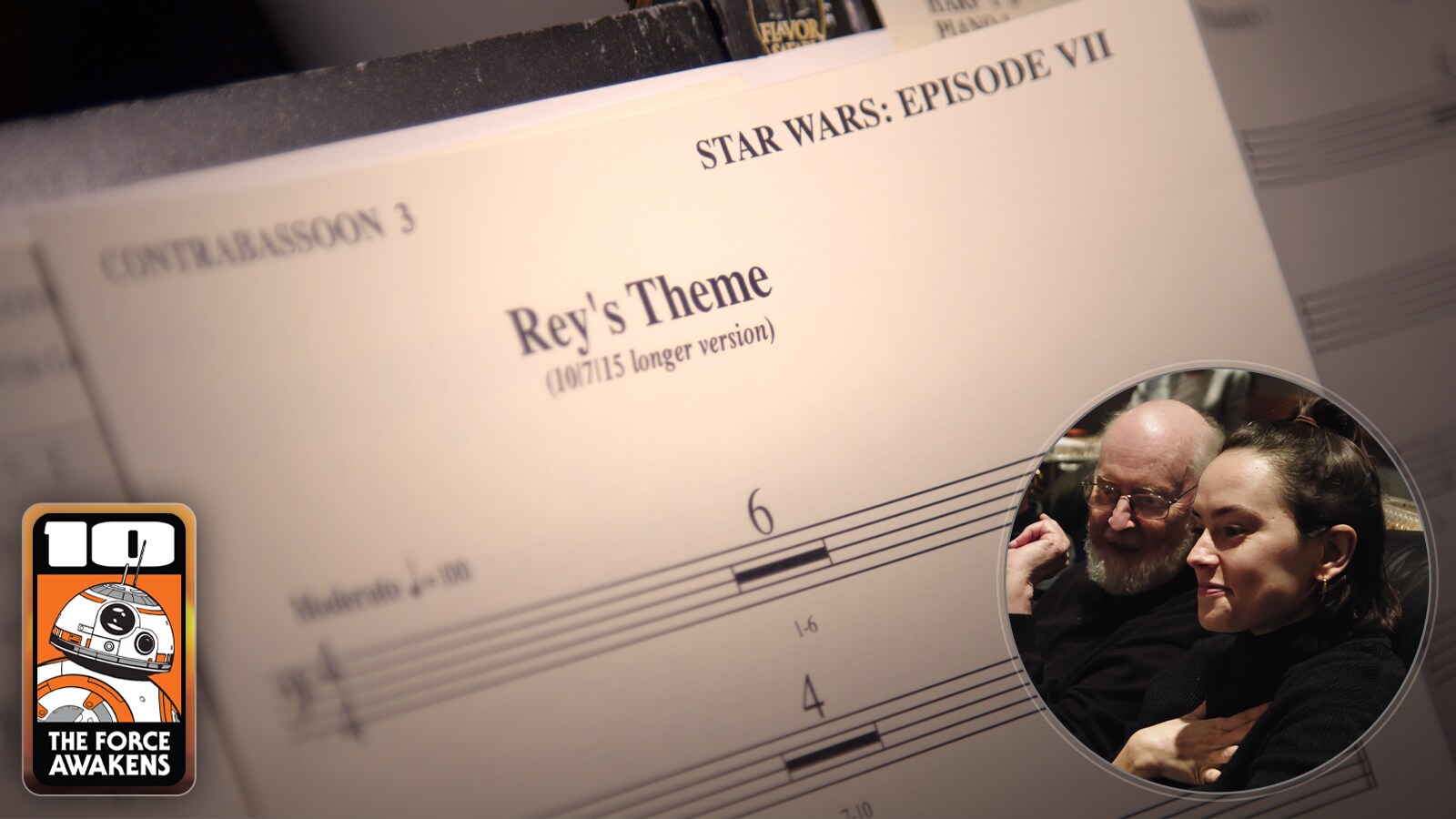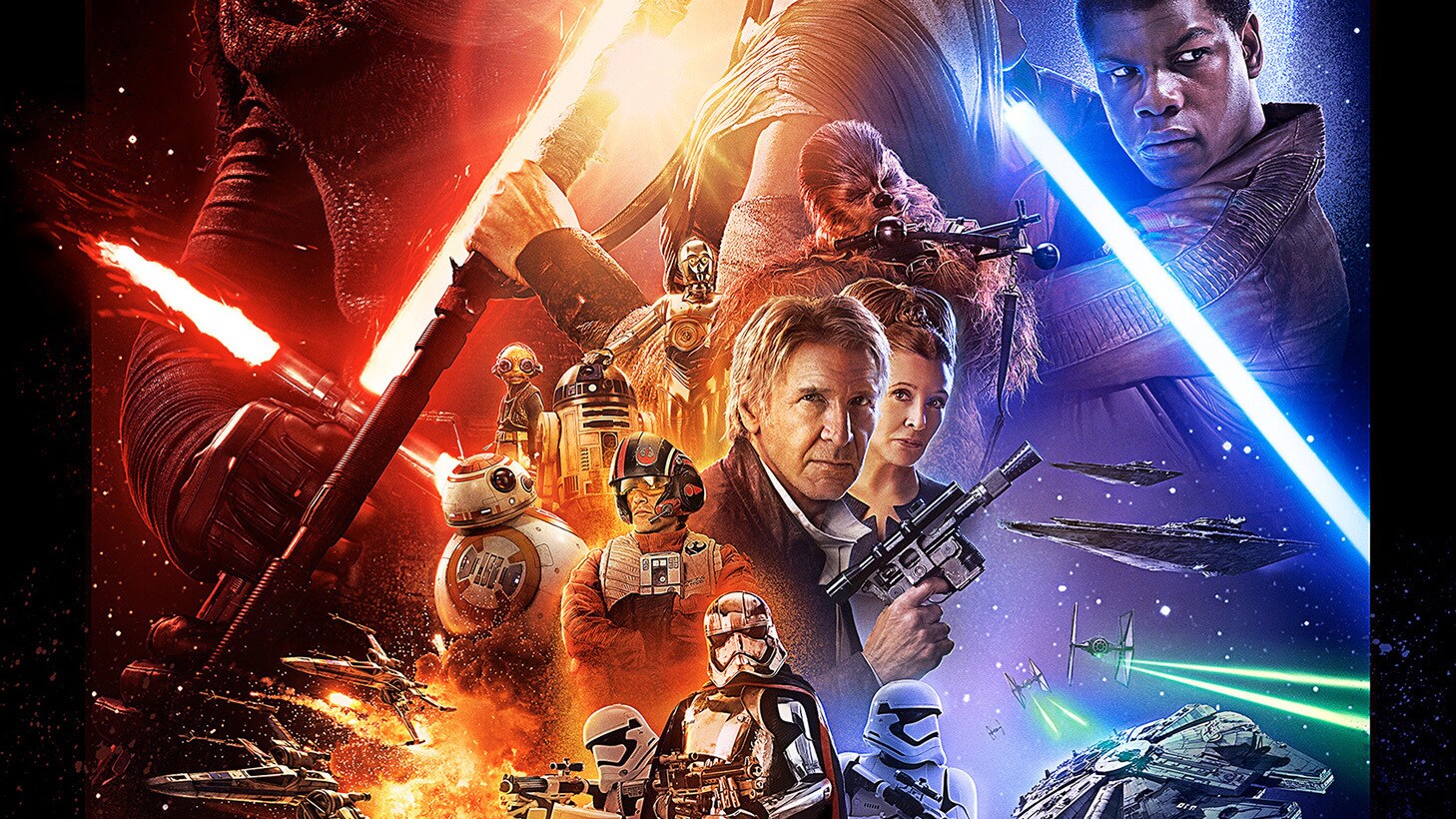

As we mark the 10th anniversary of Star Wars: The Force Awakens, which premiered in theaters December 18, 2015, StarWars.com looks back at the film that launched the sequel trilogy.
Did you know that the faceless soldiers of the First Order have a surprising connection to a certain British secret agent? We imagine FN-007 likes his blue milk shaken, not stirred.
It has been ten years since Star Wars: The Force Awakens premiered and, as we look back at the start of the sequel trilogy, it is also fun to take a peek behind the curtain. One of the most secretive, anticipated, and equally exciting movies ever released, The Force Awakens was created with exceptional care — a fact that is evident in all of the personal touches that went into its production. In honor of the film’s 10th anniversary, we’ve picked 10 of our favorite fun facts and hidden details to share with your friends and family during your next rewatch.
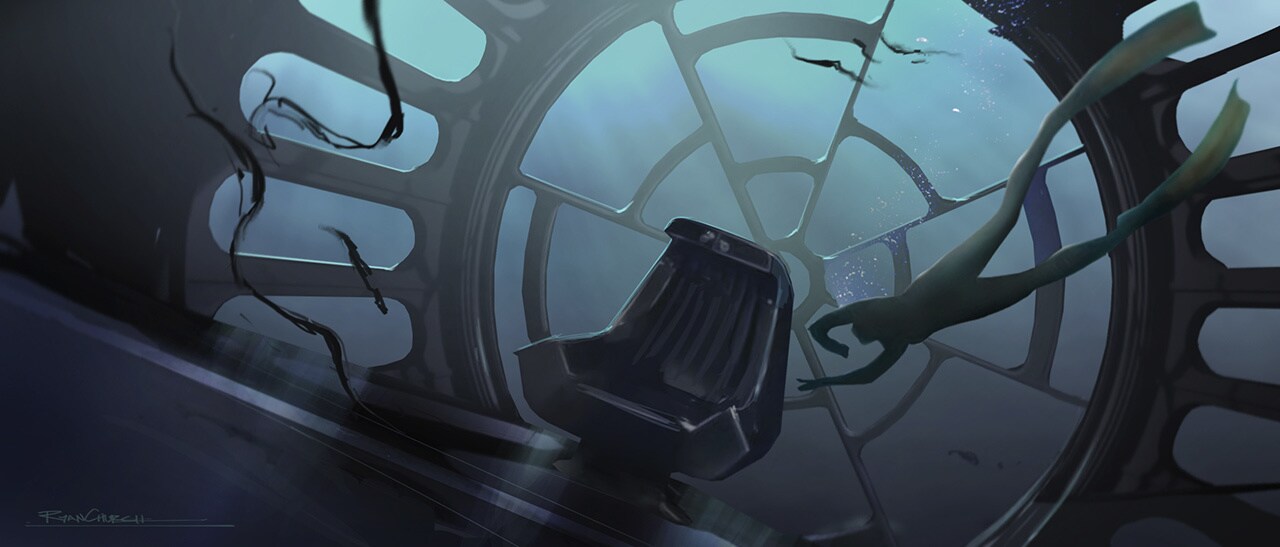
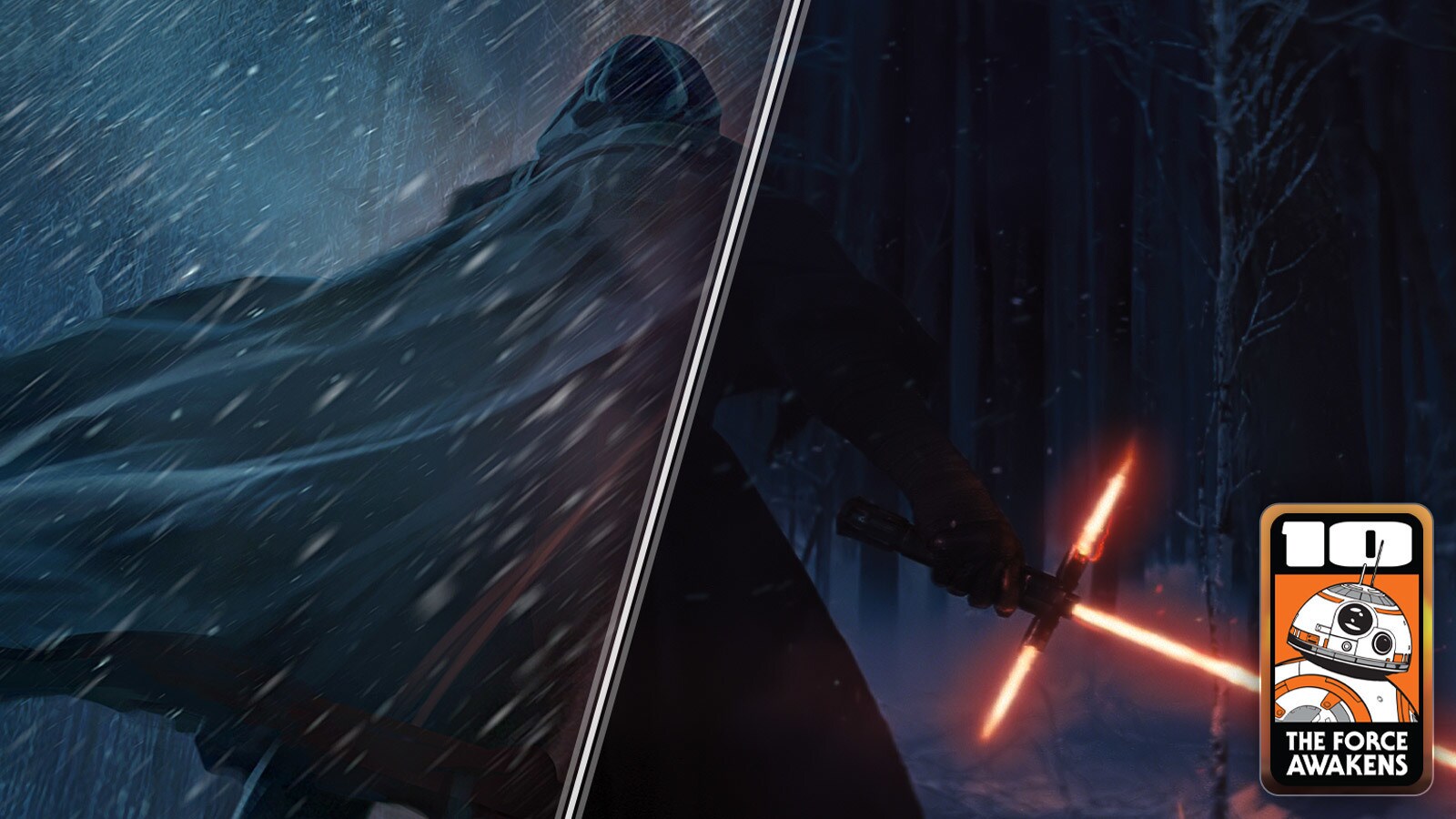
1. Save it for later. Several members of the Art Department began exploratory concept art work in 2013 during the very early pre-production phase. It was so early in the process, this was before the movie even had a finished script. Some initial (but eventually discarded) ideas were so strong that they eventually appeared later in the saga, including an early suggestion from production designer Rick Carter that the story could include a visit to the watery wreckage of the Death Star II.
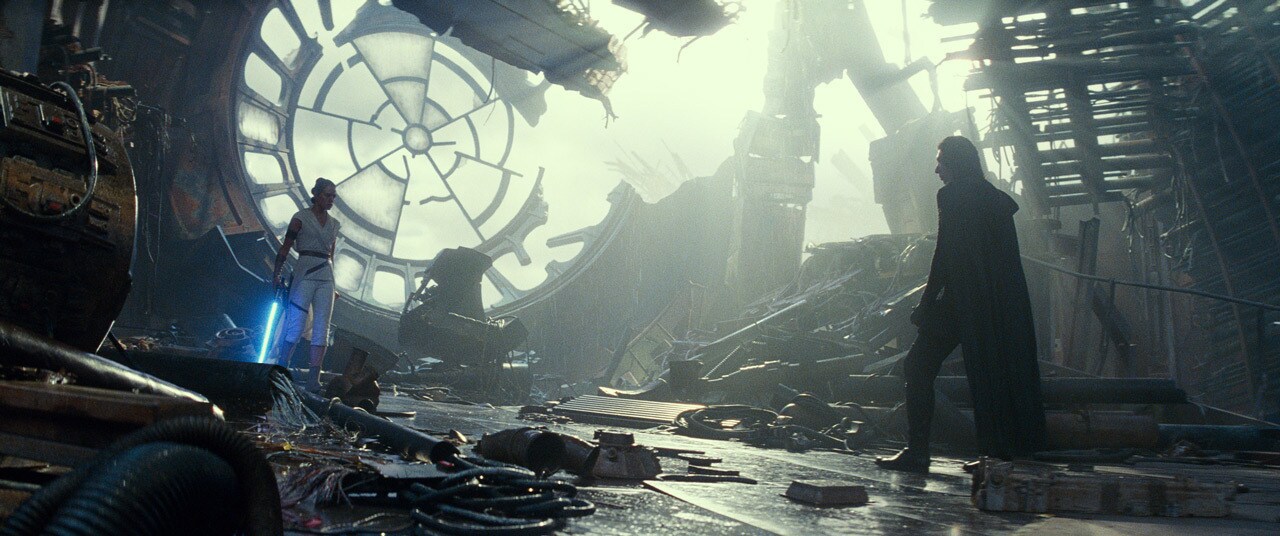
As concept artist Ryan Church recounted in The Art of Star Wars: The Force Awakens by Phil Szostak: “‘What if the Emperor’s chamber had crash-landed after the second Death Star explosion?’ That doesn’t make any sense, but that’s when Rick knows he has something.” Of course, we all know that this idea beautifully resurfaced (so to speak) in 2019’s Star Wars: The Rise of Skywalker.
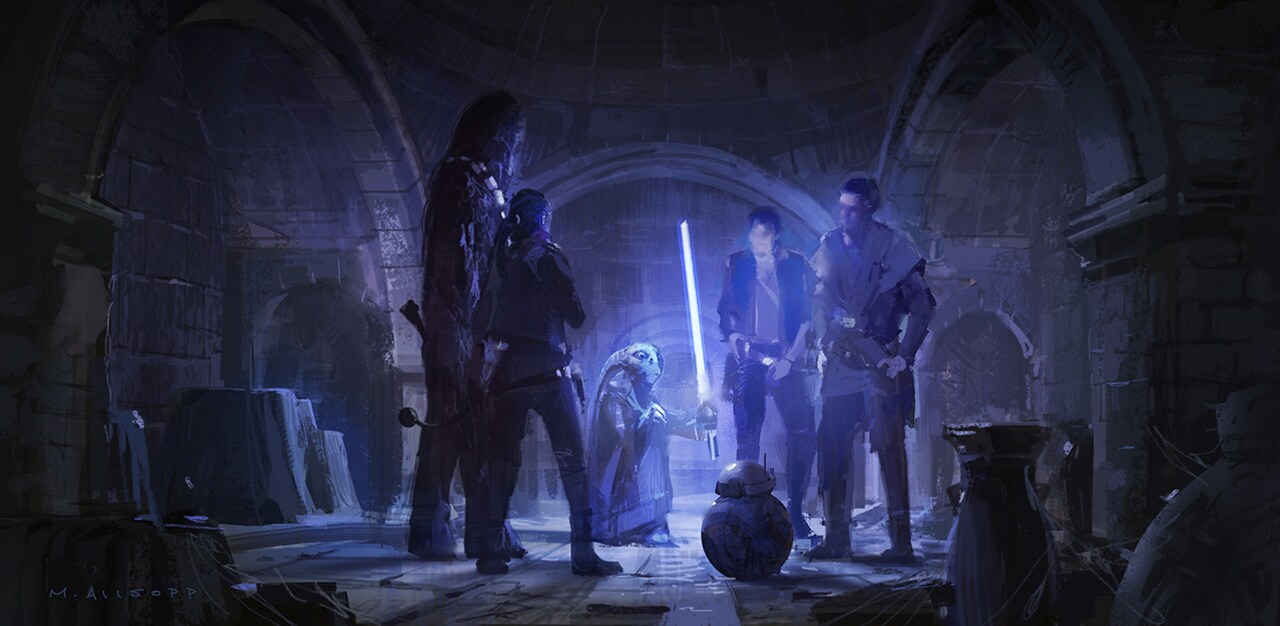
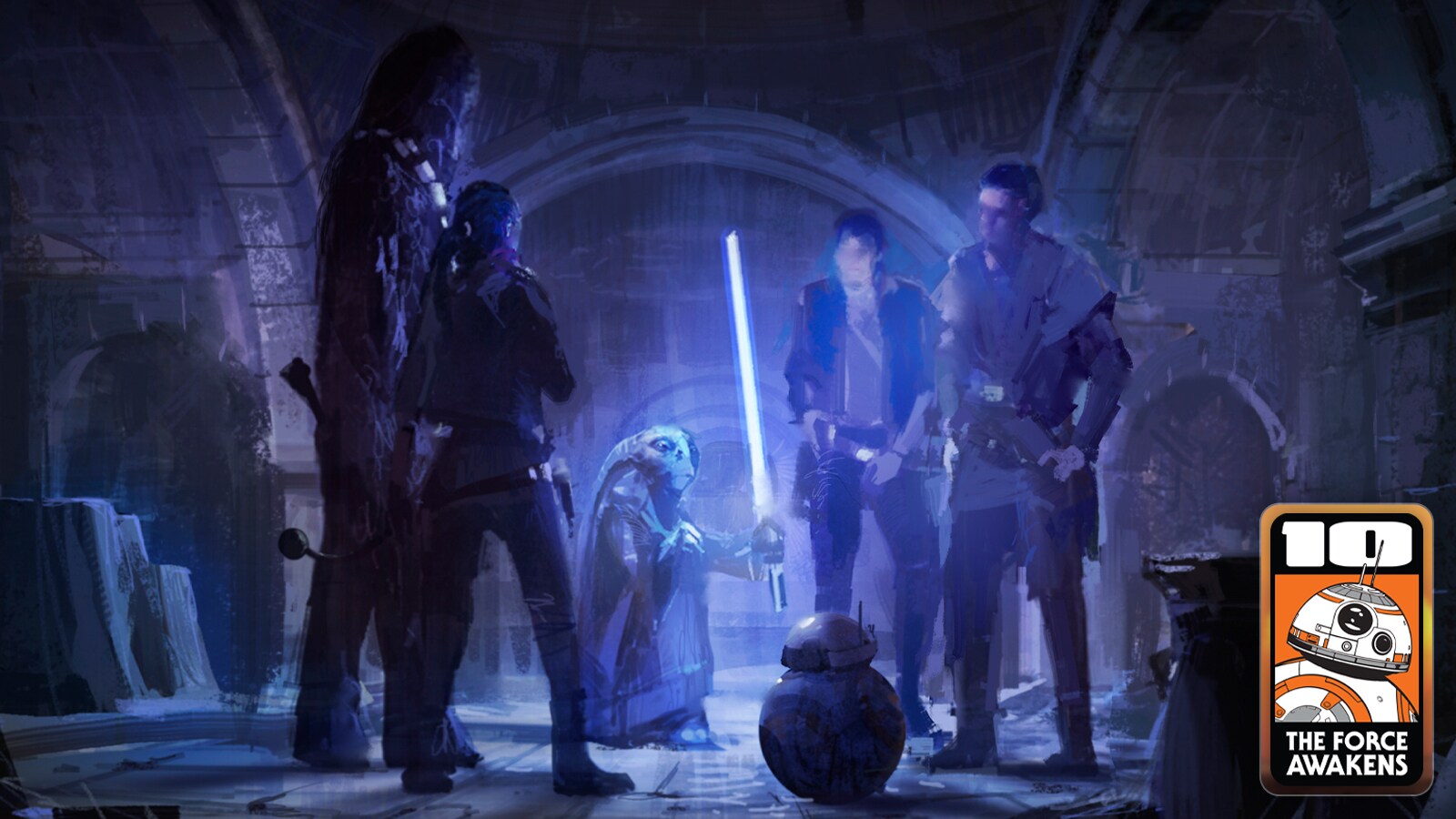
2. Gotta hand it to ‘em. The opening of The Force Awakens could have been very different. As revealed by J.J. Abrams in his director’s commentary (which appeared on the Collector’s Edition 3D Blu-ray release of the film), at one point the scene was supposed to chart the journey of Luke Skywalker’s lightsaber from the Bespin duel in Star Wars: The Empire Strikes Back all the way to Maz Kanata’s castle. “In the original script, you saw the lightsaber falling through space, and landing on the ground, and a hand taking it,” said Abrams. “You used to have this entire backstory where we learned what happened with Luke’s lightsaber over the years and how it ended up finally in the hands of Maz Kanata.”
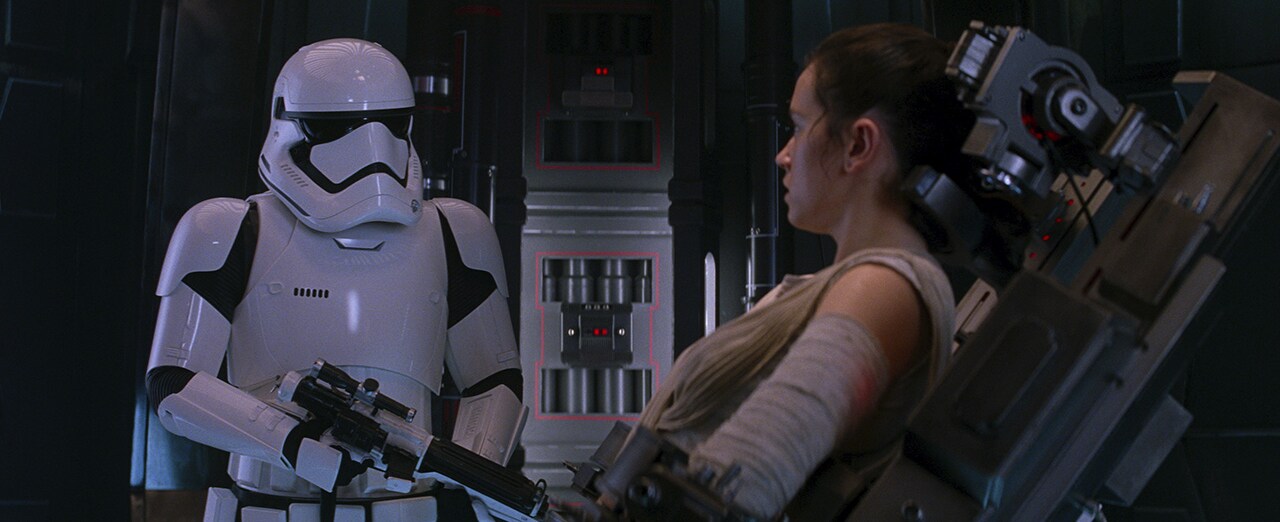
3. Bucket heads. In order to fill out the gleaming white ranks of the First Order, production turned to several famous faces for hard-to-spot cameos hidden under a helmet.
Rogue One: A Star Wars Story composer Michael Giacchino made an early appearance as the stormtrooper behind a captured Poe Dameron on Jakku. Nigel Godrich, the award-winning producer of Radiohead, was deemed by Abrams as “a good stormtrooper for .4 seconds” before getting shot later in the film. And, of course, Daniel Craig, a Star Wars fan himself, had been filming the James Bond film Spectre on the shared Pinewood Studios lot, and was brought in for a day to live out his Star Wars dreams. His stormtrooper was called FN-007 on set, now named FN-1824 — the recipient of Rey’s first Jedi mind trick. “He shot all day and was fantastic. It’s his voice too,” remembered Abrams later in his director’s commentary.
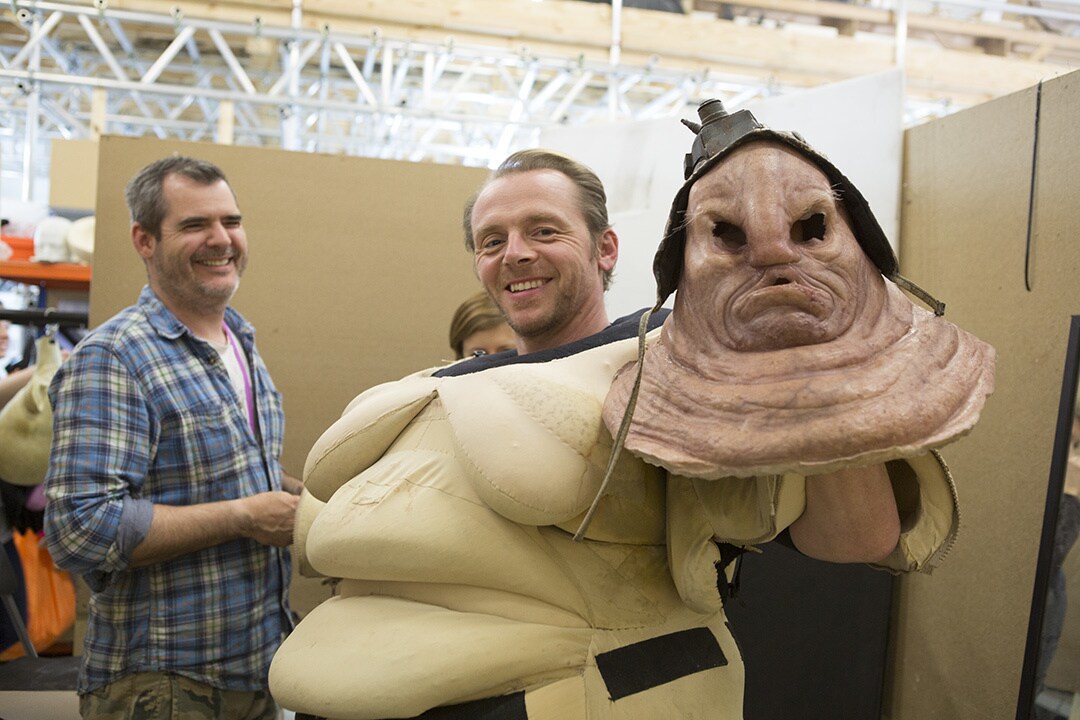
There were other cameos beyond the First Order, too! For genre fans of The Raid: Redemption and The Raid 2, martial artists Iko Uwais and Yayan Ruhian played Razzo Quin-Fee and Tasu Leach, two of the mercenaries who tracked down Han Solo. Of course, Simon Pegg — known to fans of both the Abrams-led Star Trek reboot, as well as Edgar Wright’s Cornetto Trilogy of films that launched with Shaun of the Dead — donned heavy prosthetics as Unkar Plutt. “I burn for Star Wars,” Pegg boasted in between sweltering takes in the Abu Dhabi sun.
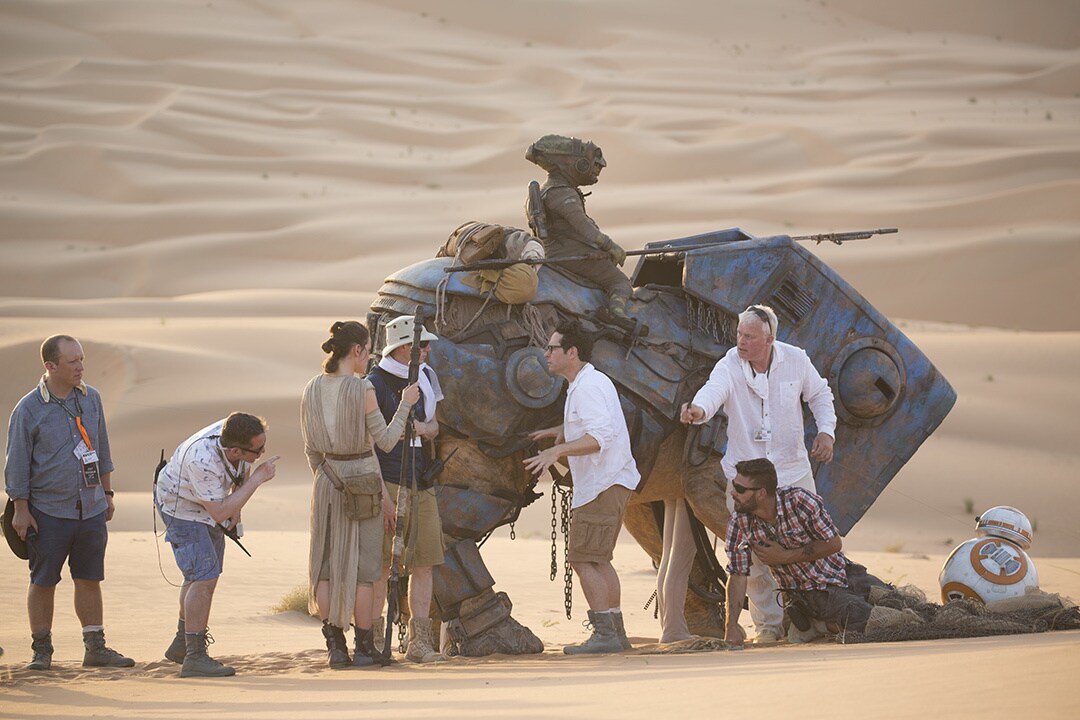
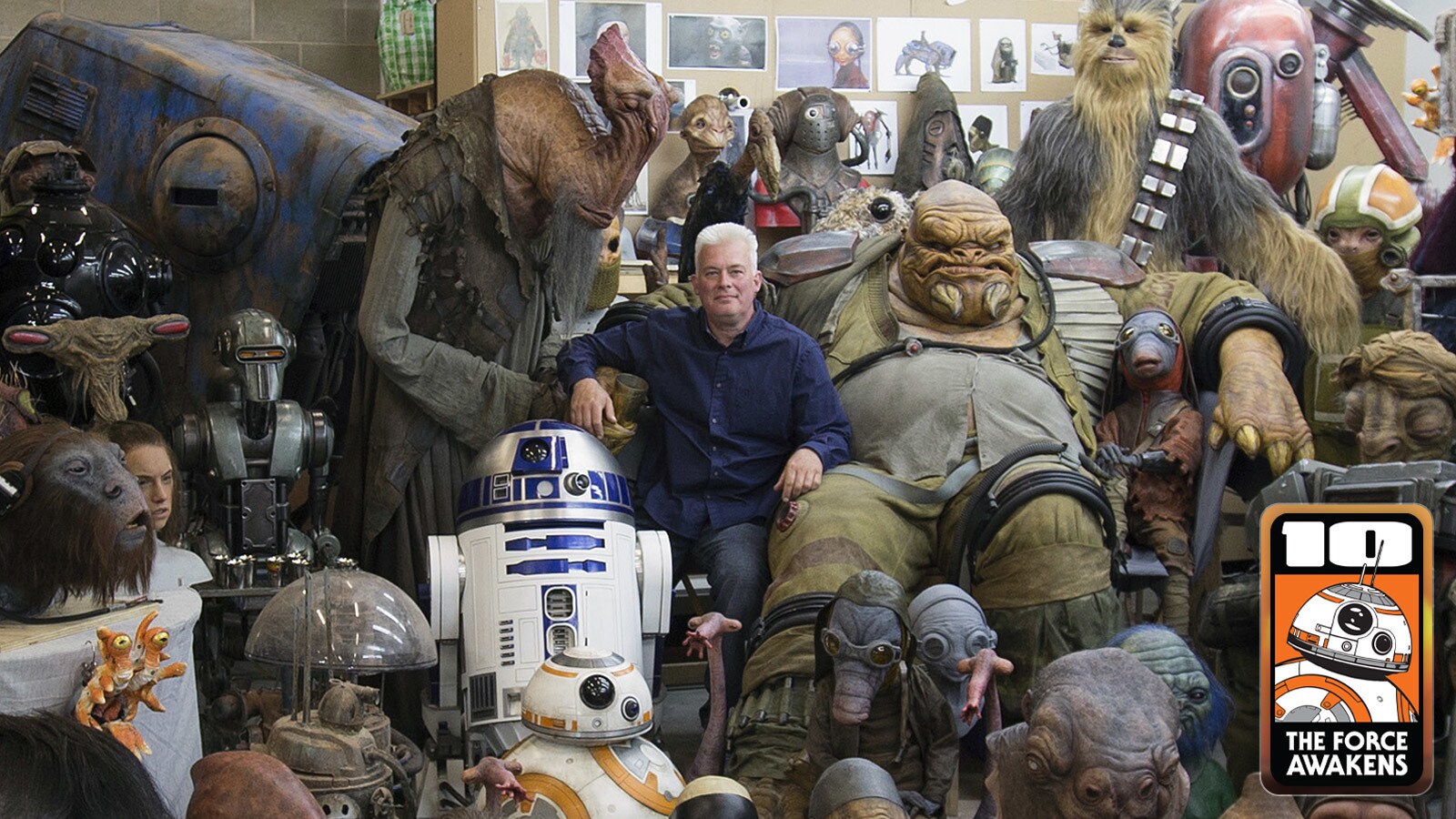
4. It takes a village. Determined to balance tangible, practical effects with computer-generated visual effects, a couple of scene-stealing creatures required an army of talent to bring them to life. The lumbering luggabeast, for example, featured the work of performers Derek Arnold and Tom Wilton inside the creature with Kiran Shah riding on top as the wily alien Teedo and BB-8 controlled by puppeteer Brian Herring. It’s a seemingly simple scene, but that makes Daisy Ridley the only unmasked human on screen! When you then take into consideration all of the concept artists and creature fabricators and designers (and eventual visual effects wizards), this one scene becomes a microcosm of the magical moviemaking experience.
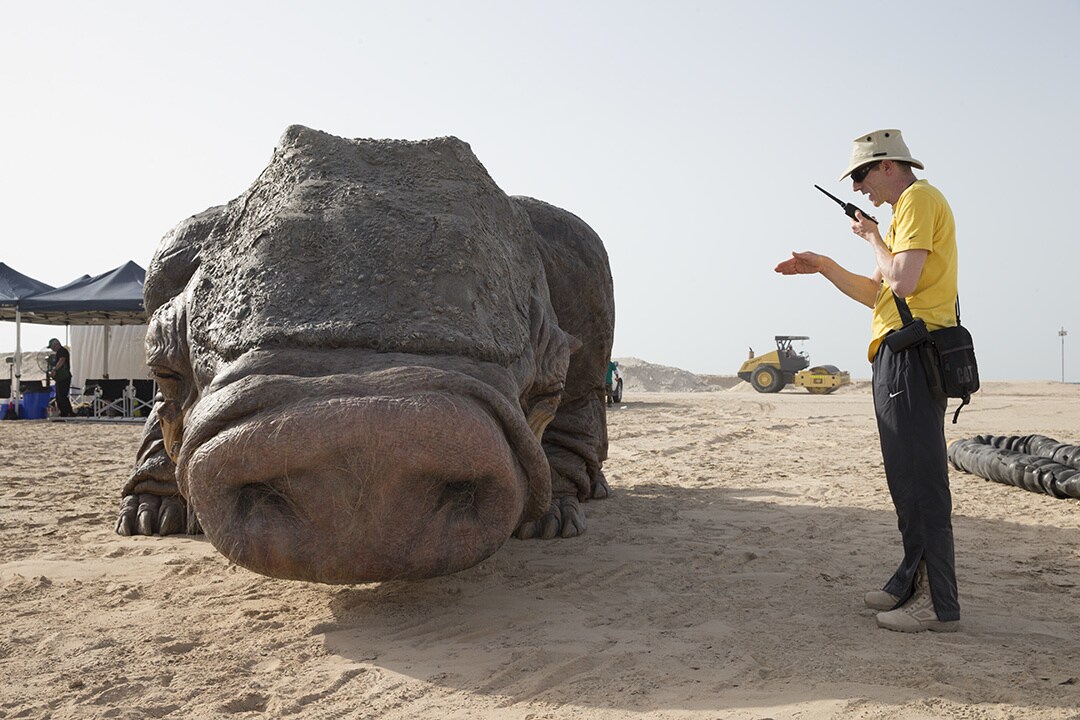
Similarly, the happabore, co-star of a later scene with a very thirsty Finn, took five different puppeteers inside. The beast’s final design, however, was pitched to Abrams in a very unusual way. As concept artist Jake Lunt Davies remembers in The Art of Star Wars: The Force Awakens: “J.J. did his first tour of our workshop, and we rounded it off by having this enormous thing charge out of a side door into the main warehouse. It was a risk. Fortunately, he loved it.” The amount of effort for a singular unforgettable moment is rather astonishing.
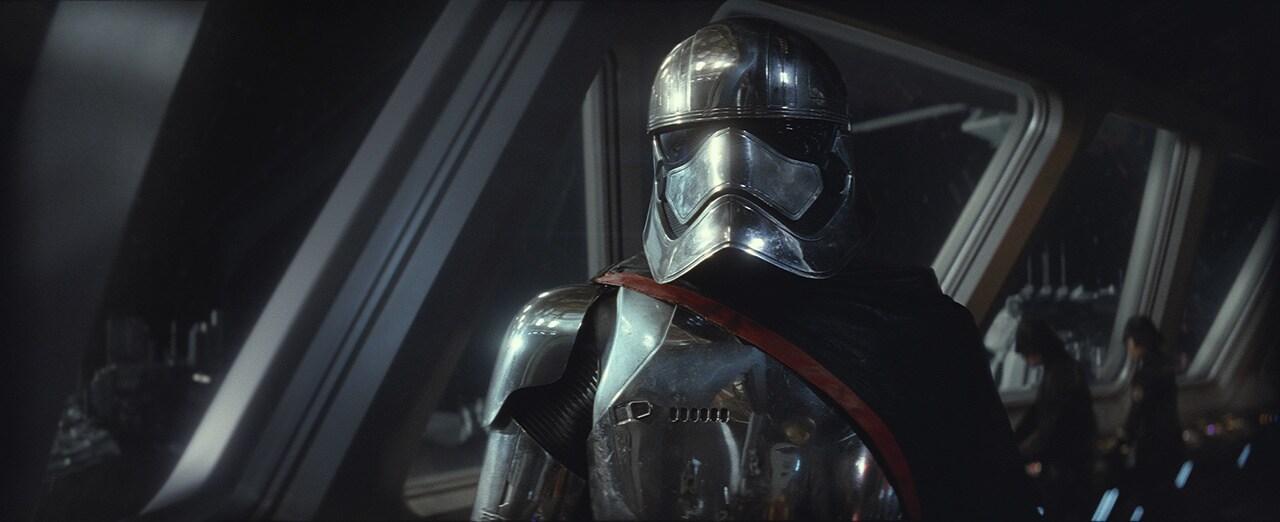
5. What’s in a name? “Booooy!” For the gleaming Captain Phasma’s name, Abrams was directly inspired by a childhood horror favorite. Phasma’s shiny chrome armor reminded him of Don Coscarelli’s Phantasm, which featured a chrome ball (the lethal “Sentinel Sphere”), hence the name “Phasma.” Abrams’ company Bad Robot also performed a 4K restoration of Coscarelli’s 1979 classic.
In the years since, storytellers have added to the lore, connecting Phasma’s brushed armor to a certain Emperor Palpatine. As the story goes, the materials were salvaged from Palpatine’s chromium-built yacht.
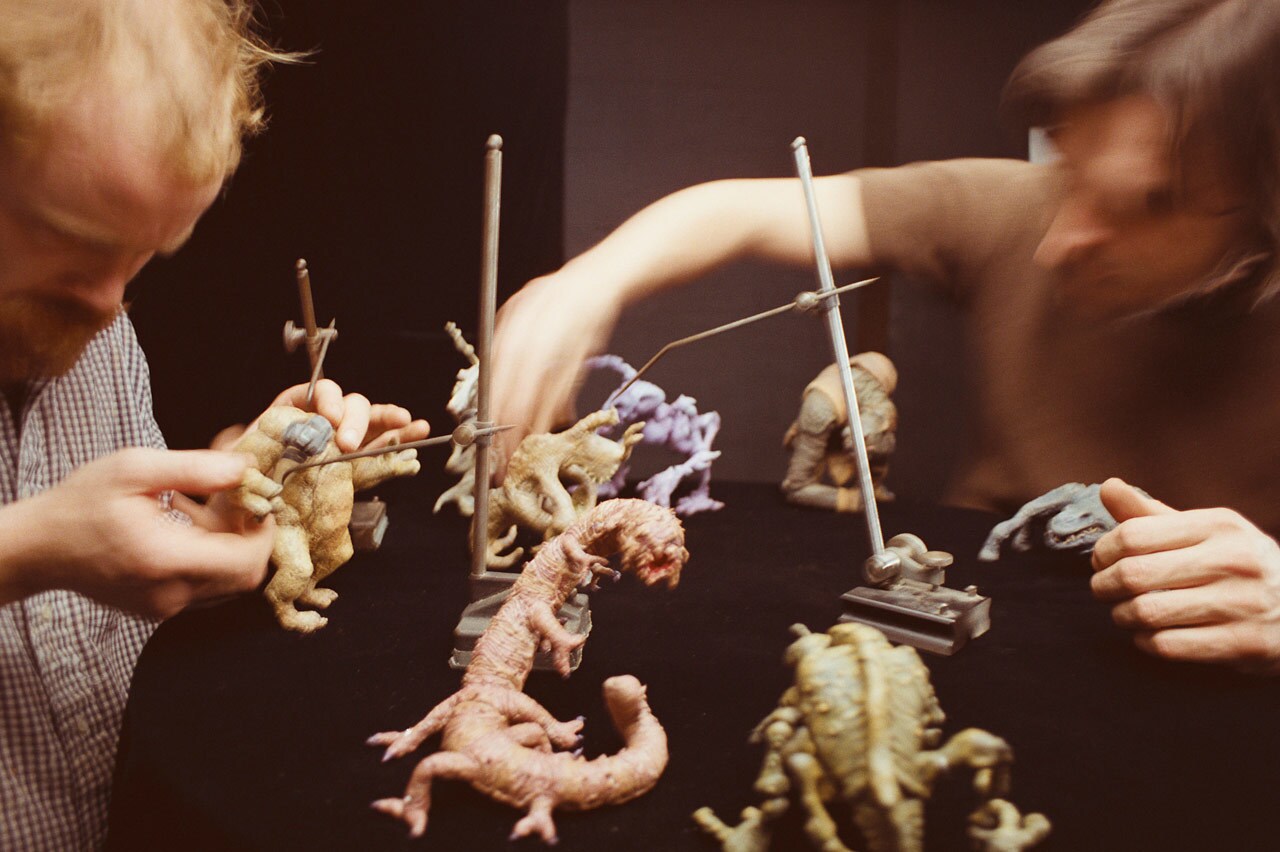
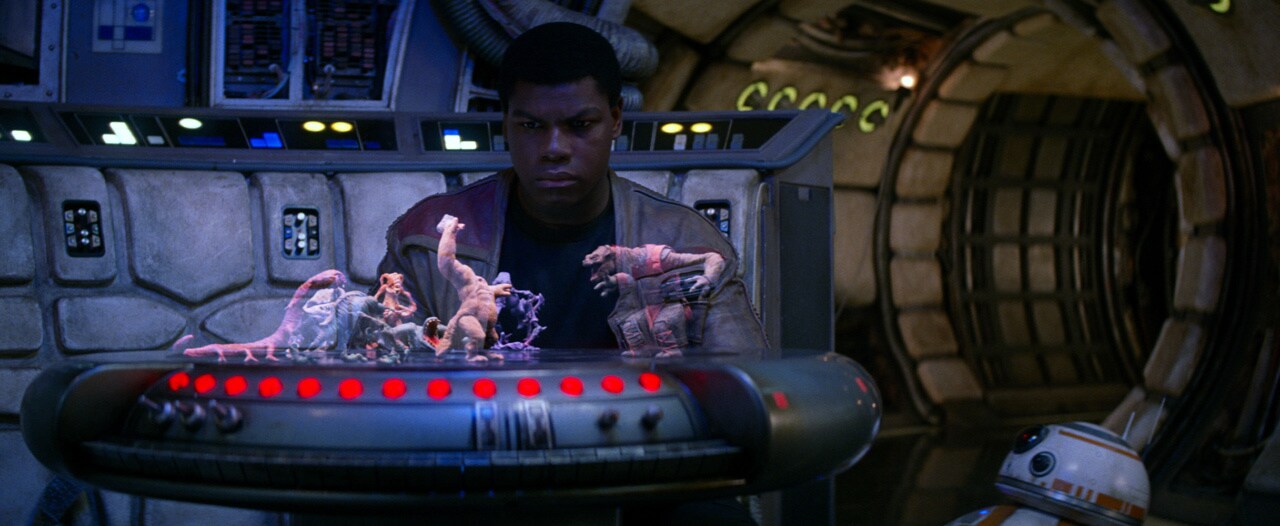
6. Let the Wookiee win. Many fans quickly spotted the return of the dejarik holochess aliens aboard the Millennium Falcon in The Force Awakens. Eagle-eyed fans, however, might have noticed something extra cool — the monsters on display picked up exactly where they left off at the end of their 1977 debut. Legendary filmmaker Phil Tippett and animators from Tippett Studio used stop-motion techniques to directly counter-attack R2-D2’s move from the original film. It was highly-detailed work, with the Tippett Studio artisans using the original stop-motion puppets from A New Hope as reference, as well as photogrammetry, 3D printing, compositing, and silicone casting.
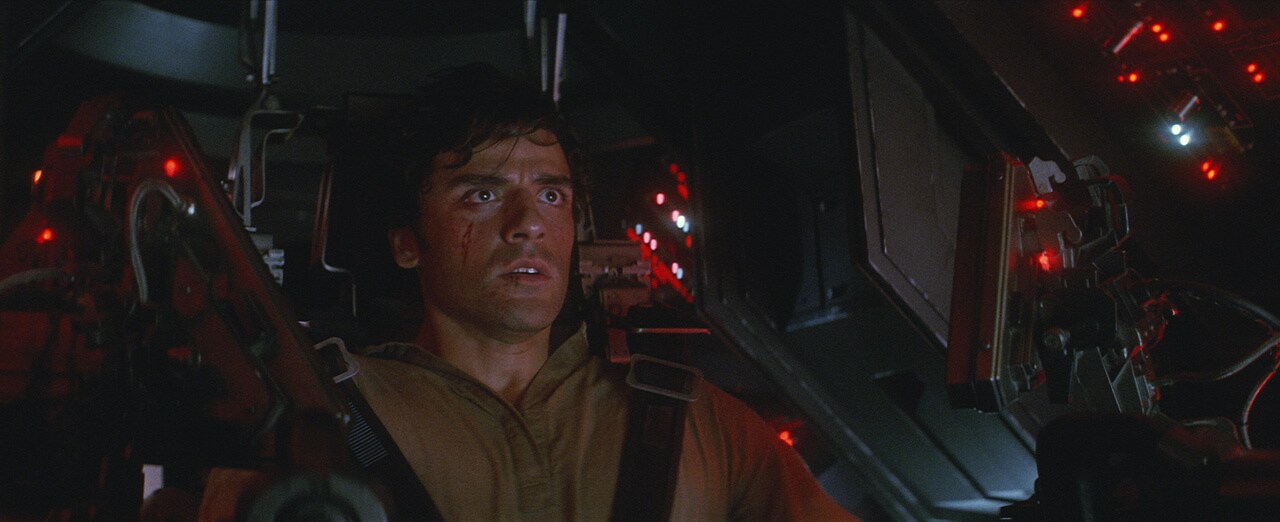
7. Happy beeps! Poe Dameron lives. It’s hard to believe now, but the character of Poe Dameron wasn’t intended to go beyond The Force Awakens. The dashing Resistance pilot was originally slated to perish during the escape from the Star Destroyer near the beginning of the film. As Abrams said, “Originally, when I thought of Poe… Larry Kasdan and I wrote the script, and we just killed him. When I showed the script to Oscar Isaac, who I really wanted to be in the movie, he said he wanted to do it, but he had died in four other movies in the first act. Was there any way he could live?”
Thankfully, the answer was yes and the rest is cinematic history.
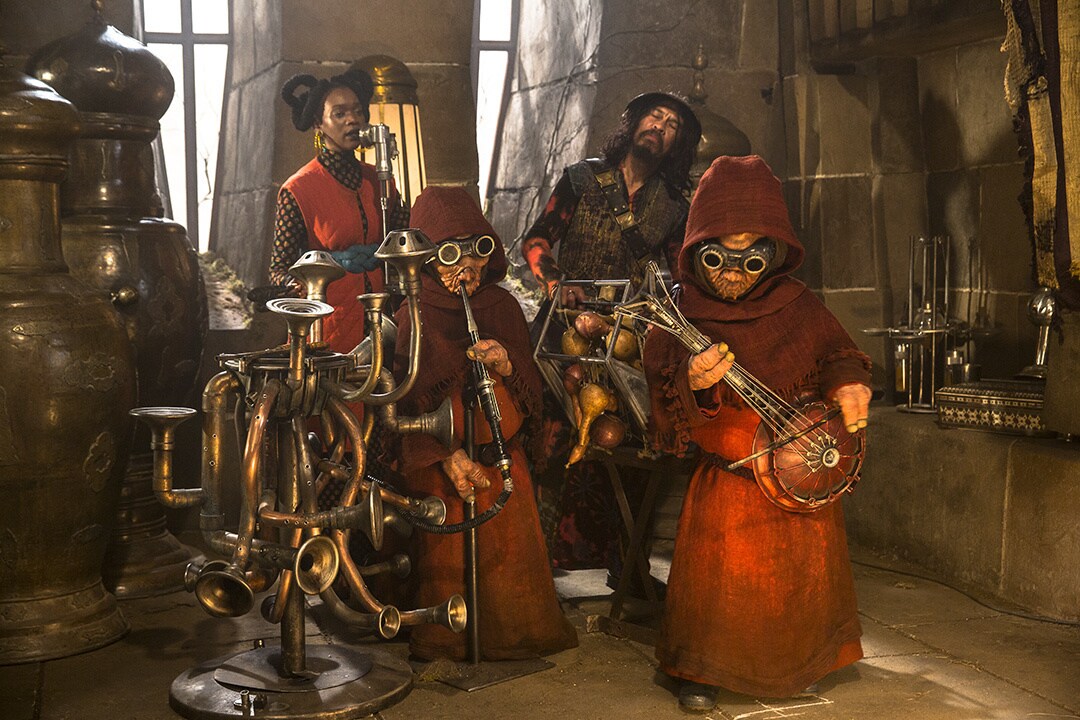
8. He’s not throwing away his shot. If you listen closely to the background sounds of Maz Kanata’s castle, you may recognize a familiar voice. Composer John Williams had asked Abrams if the director could find someone else to compose the diegetic music, so that the composer could focus on the new themes for the movie. Abrams contacted Emmy, Grammy, and Tony-winner Lin-Manuel Miranda to help write the newest cantina-esque tune, dubbed “Jabba Flow.” Both Miranda and Abrams also sing on the track — marking the director’s cameo.
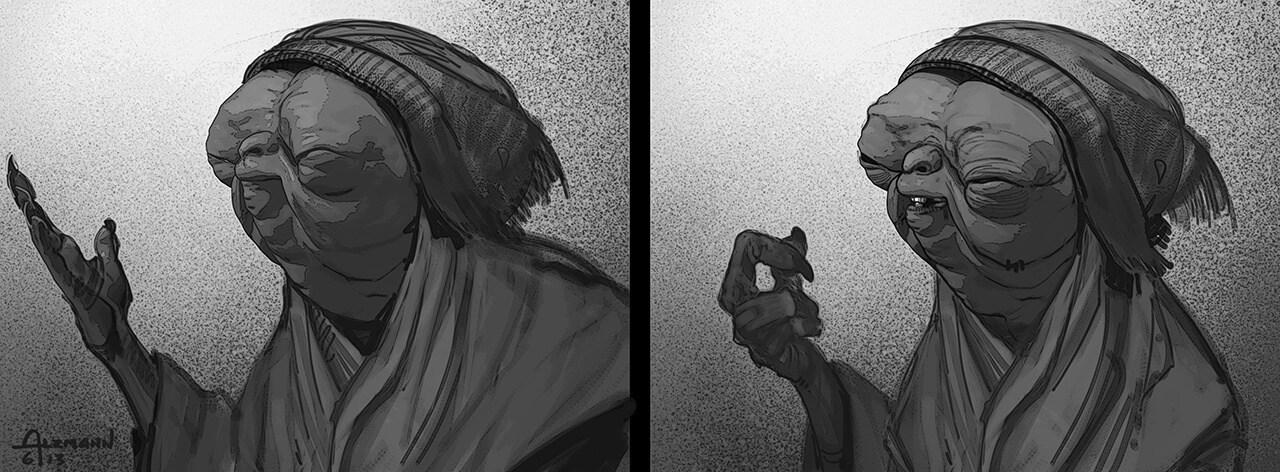
9. Same eyes in different people. Early in Episode VII’s development, Rick Carter and J.J. Abrams discovered that they both had a common mentor: award-winning and universally adored Palisades High School teacher Rose Gilbert. She had retired at the age of 94 in early 2013 (and had passed away later that year). In tribute, concept artists Christian Alzmann and Iain McCaig were tasked with creating Maz after “a really inspiring, funny, glasses-wearing, brilliant teacher,” recounted Abrams.
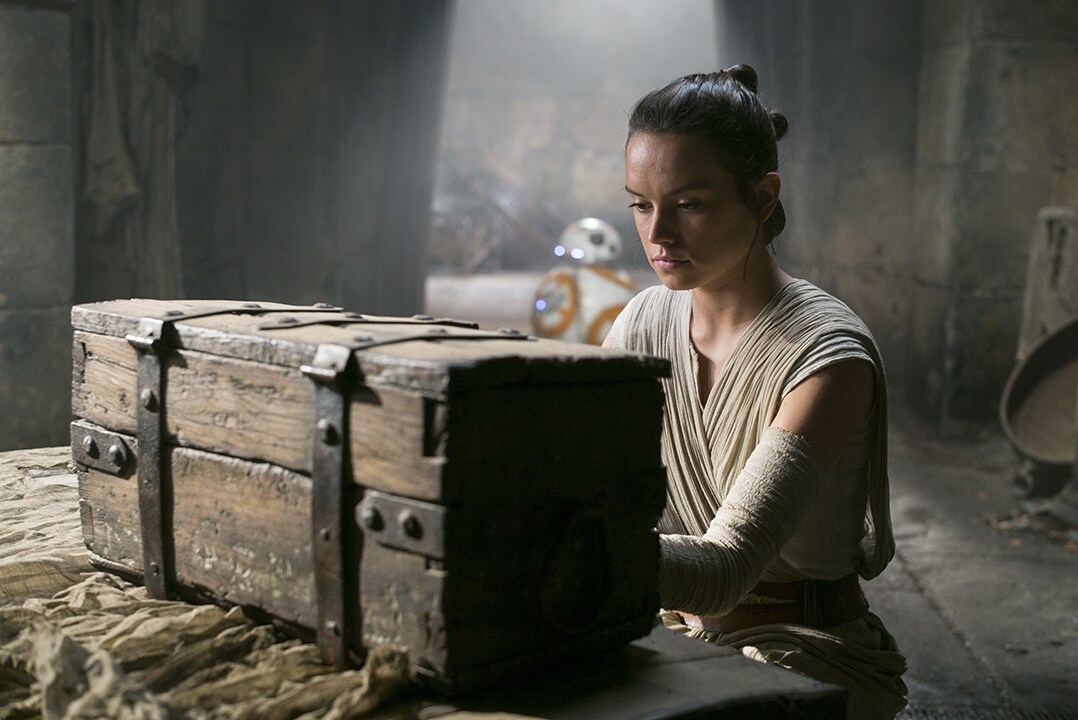
10. Force-back to the Future. When Rey touches the lightsaber hilt hidden away in Maz Kanata’s castle, she enters what the filmmakers referred to as the “Force-back,” a swirling sequence of images, sounds, and feelings. Much of the Force-back remains in the movie (including glimpses of the Knights of Ren and the remains of Luke Skywalker’s Jedi Temple), but one moment was filmed and cut: the Bespin duel. Rey would have looked down the hall to see Luke and Darth Vader actually fighting in the iconic scene from The Empire Strikes Back.
During the very end of the Force-back, listen closely to hear the iconic voice of the original Obi-Wan Kenobi, Alec Guinness, saying, “Rey.” How can that be? According to Abrams, it was producer Brian Burk’s idea. They found a vintage recording of Guinness saying “Great” and isolated the sound. Then the prequel trilogy’s Kenobi, Ewan McGregor, came in and recorded the rest of the line, “These are your first steps.”