• More More

Search

My Account Logout
  • other
  • instagram
  • twitter
  • facebook
  • youtube
  • other
  • NEWS + FEATURES
    • THE LATEST
    • MAUL - SHADOW LORD
    • THE MANDALORIAN AND GROGU
    • QUIZZES + POLLS
    • BOOKS + COMICS
  • VIDEO
  • FILMS
  • SERIES
    • All Series
    • MAUL - SHADOW LORD
    • Andor
    • Ahsoka
    • The Mandalorian
  • GAMES + INTERACTIVE
    • View All
    • Games + Apps
    • VR + Interactive
  • DATABANK
    • ALL DATABANK
    • GALAXY MAP
    • ERAS
  • DISNEY+
    • STREAM NOW
    • EXPLORE DISNEY+
    • THE DISNEY BUNDLE
  • More More
My Account Logout
  • other
  • instagram
  • twitter
  • facebook
  • youtube
  • other

STAR WARS ON DISNEY+

All

  • Star Wars: Maul - Shadow Lord
  • The Mandalorian and Grogu
  • Star Wars: Starfighter
  • Andor
  • Rogue One
  • Series
  • Films
  • Disney+
  • Games + Interactive
  • Books + Comics
  • Merchandise
  • LEGO Star Wars: Rebuild the Galaxy
  • Visions
  • The Mandalorian
  • Ahsoka
  • Skeleton Crew
  • The Acolyte
  • Obi-Wan Kenobi
  • The Book of Boba Fett
  • The Bad Batch
  • The Clone Wars
  • Interviews
  • Collecting
  • Creativity
  • Disney Parks
  • Events
  • Fans + Community
  • LEGO Star Wars
  • Lucasfilm
  • Quizzes + Polls
  • Recipes
  • Star Wars Rebels
  • Star Wars Celebration
  • The High Republic
{:title=>"Lucasfilm", :url=>"https://www.starwars.com/news/category/lucasfilm"} {:title=>"Films", :url=>"https://www.starwars.com/news/category/films"}

Star Wars: A New Hope Began Filming 50 Years Ago Today

March 22, 2026
March 22, 2026
Lucas Seastrom

On March 22, 1976, one of the most iconic films in history commenced principal photography in the deserts of Tunisia. It was a long road to reach that day, and there was an even longer one ahead.

On March 22, 1976, the world changed, only no one knew it yet. On that morning 50 years ago, in the middle of a salt flat on the edge of North Africa’s Sahara Desert, an independent movie produced by Lucasfilm and financed by 20th Century Fox began principal photography. Its working title was The Star Wars.

Writer and director George Lucas was 31 years old that Monday. Having grown up in the small California town of Modesto, he was already a rising star among an emerging generation of American filmmakers. His first feature film, 1971’s bold and philosophical THX 1138, showed visionary potential but was a commercial failure. His second feature, 1973’s soulful and hilarious American Graffiti, became one of the most successful films of its time. Many were following the young filmmaker's career with great interest, however few could understand the vision behind his newest project.

In truth, The Star Wars wasn’t all that different in theme from THX or Graffiti. A young boy from a backwater town seeks to break out and pursue his dreams. It was the setting of this newest film that struck so many as odd: a space fantasy realm that seemed equally inspired by Sergio Leone’s Westerns, Walt Disney’s fairy tales, and Akira Kurosawa’s epics. Lucas wanted to bring mythic dimensions to the operatic stories made popular decades earlier by the likes of Flash Gordon and Buck Rogers.
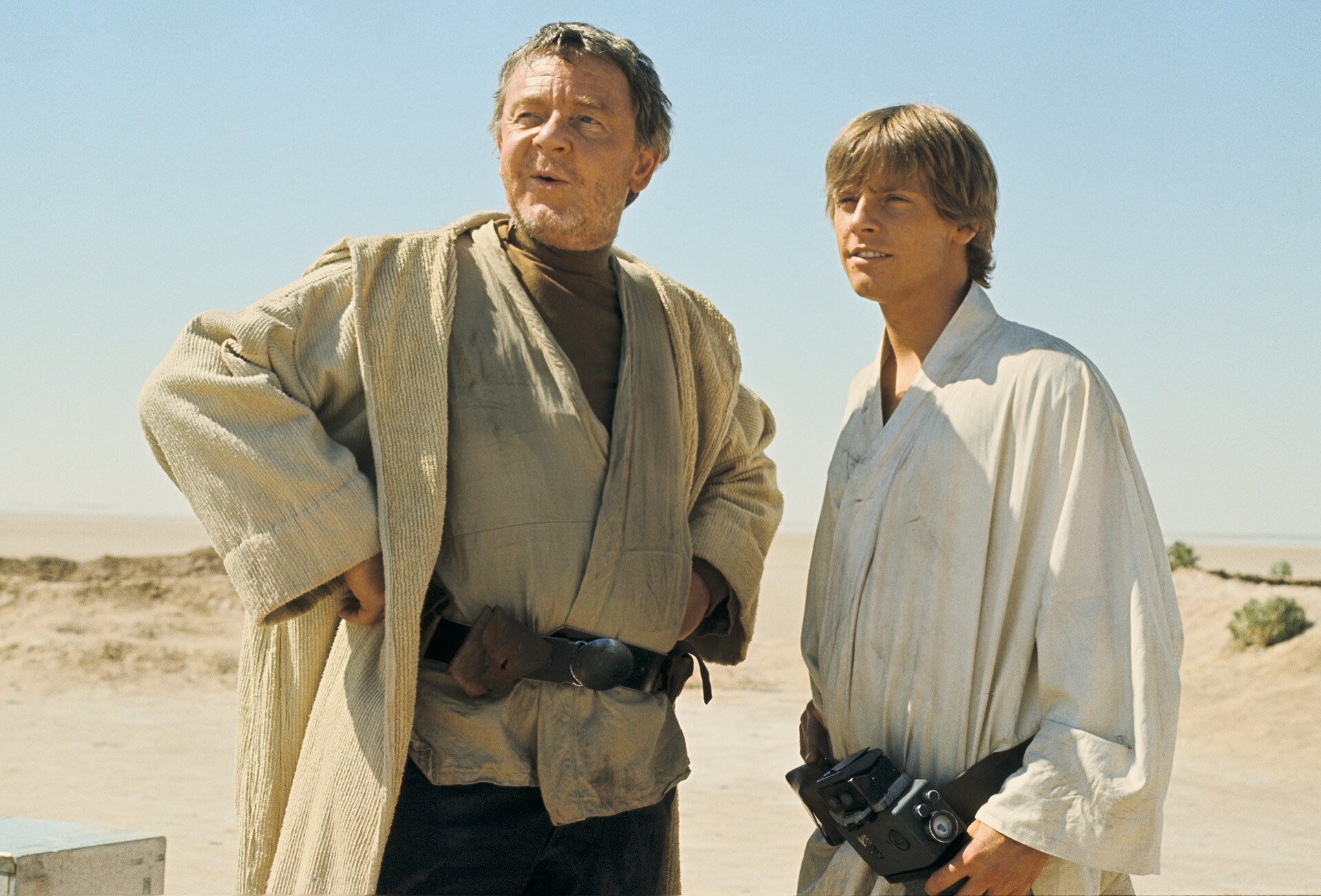
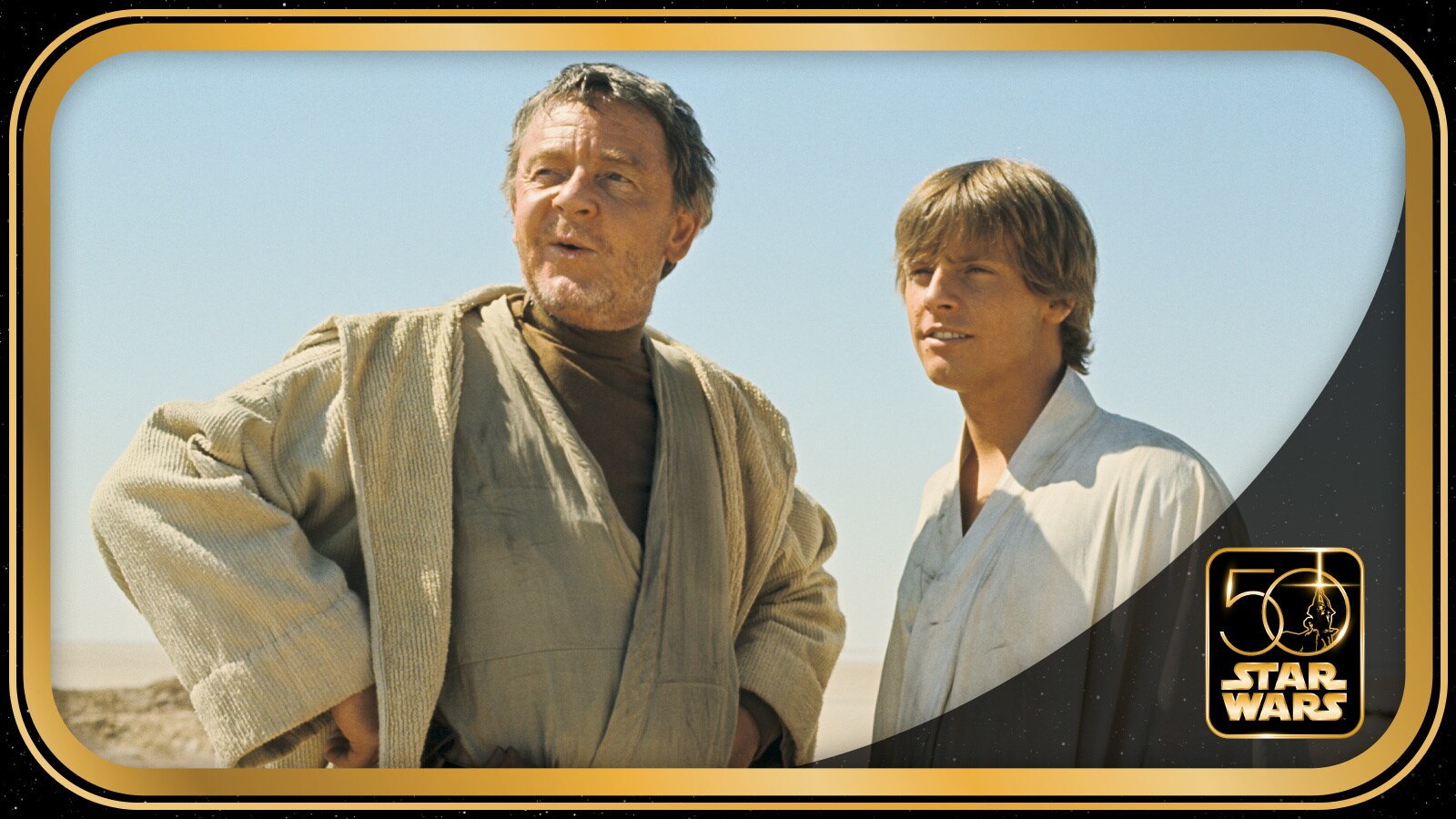
Actors Phil Brown (left, Uncle Owen) and Mark Hamill (Luke Skywalker) were among the first in front of the cameras.

Years of intense work had led to that sunny morning in Tunisia. Lucas had overcome rejection from nearly every studio in Hollywood only to face increasing skepticism and adversity from the one studio that had agreed to take on his project in 20th Century Fox. He’d worked to establish his own visual effects company, Industrial Light & Magic; hire his own sound designer, Ben Burtt; cast dozens of actors; lead dozens more artists and craftspersons on two continents in the creation of an entire galaxy; and most importantly, he’d labored through multiple screenplay drafts, nearing completion mere days ahead of the shoot.

Now, Lucas was leading the film’s cast and crew from their home base at England’s EMI Elstree Studios into the African desert, standing in as the fictional planet of Tatooine.
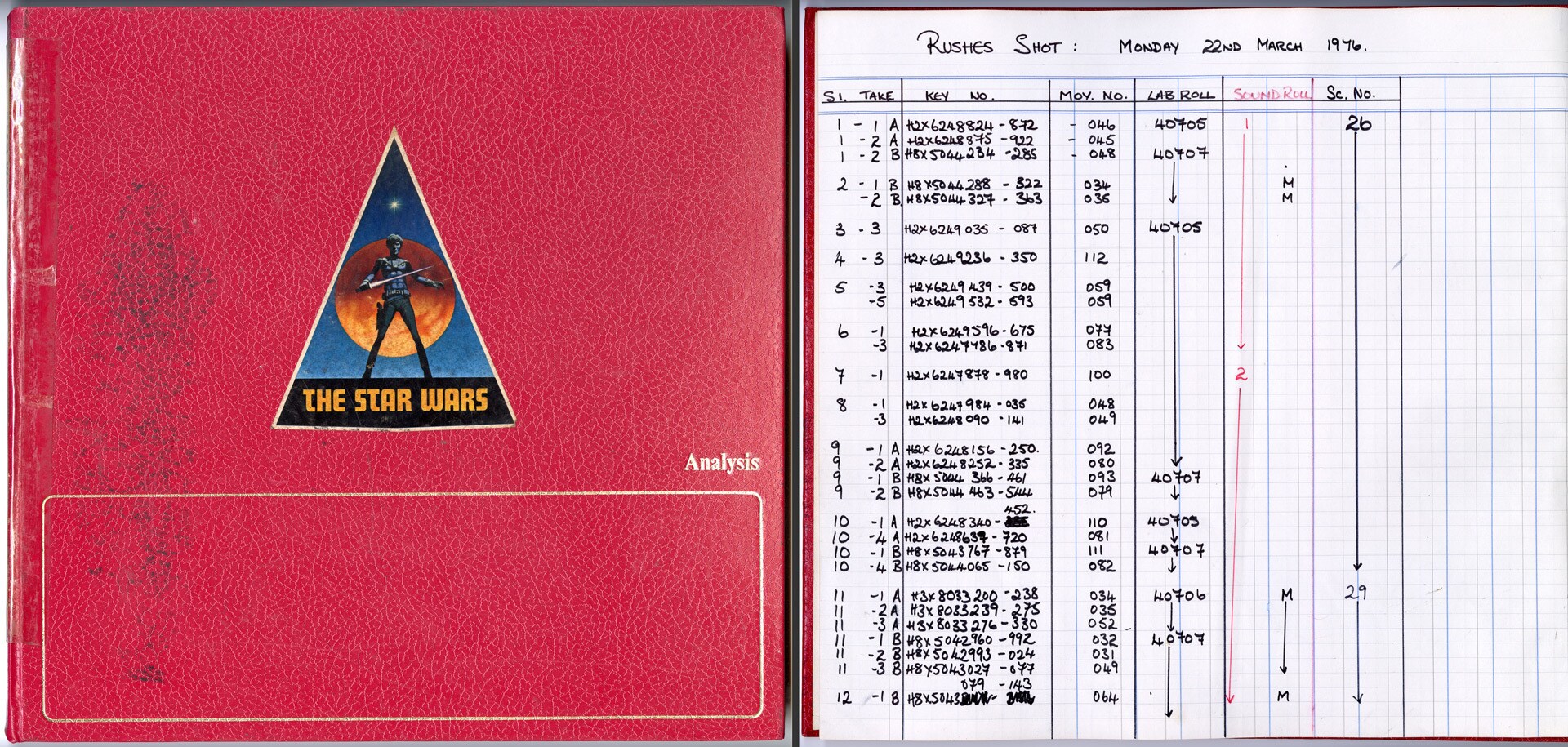
The cover and first page of the Rushes Book for Star Wars: A New Hope, which was used to record technical details for each shot that was filmed. Throughout production, equipment and logs were typically adorned with Ralph McQuarrie’s original logo design, which depicted Luke Starkiller, as he was still known on the first day of the shoot.

“Action!”

The first shot captured for The Star Wars was from Scene 26, when the Jawas present their batch of droids for sale to Owen Lars (Phil Brown) and his nephew, frustrated farm boy Luke Skywalker (Mark Hamill). As was typical for the ever resourceful Lucas and his documentary-infused shooting style, two cameras covered the set-up simultaneously. Cinematographer Gilbert Taylor, known as Gil, was supervising. At 61, Taylor brought more than 45 years of experience in filmmaking to the project.

The unit’s A camera, a Panaflex with a 35mm lens, was operated by Ronnie Taylor, a wide shot that established the location of the Jawa sandcrawler vehicle at right with the Lars homestead at left, with a group of Jawas, some of whom were played by local children, seen running up alongside the sandcrawler’s treads.
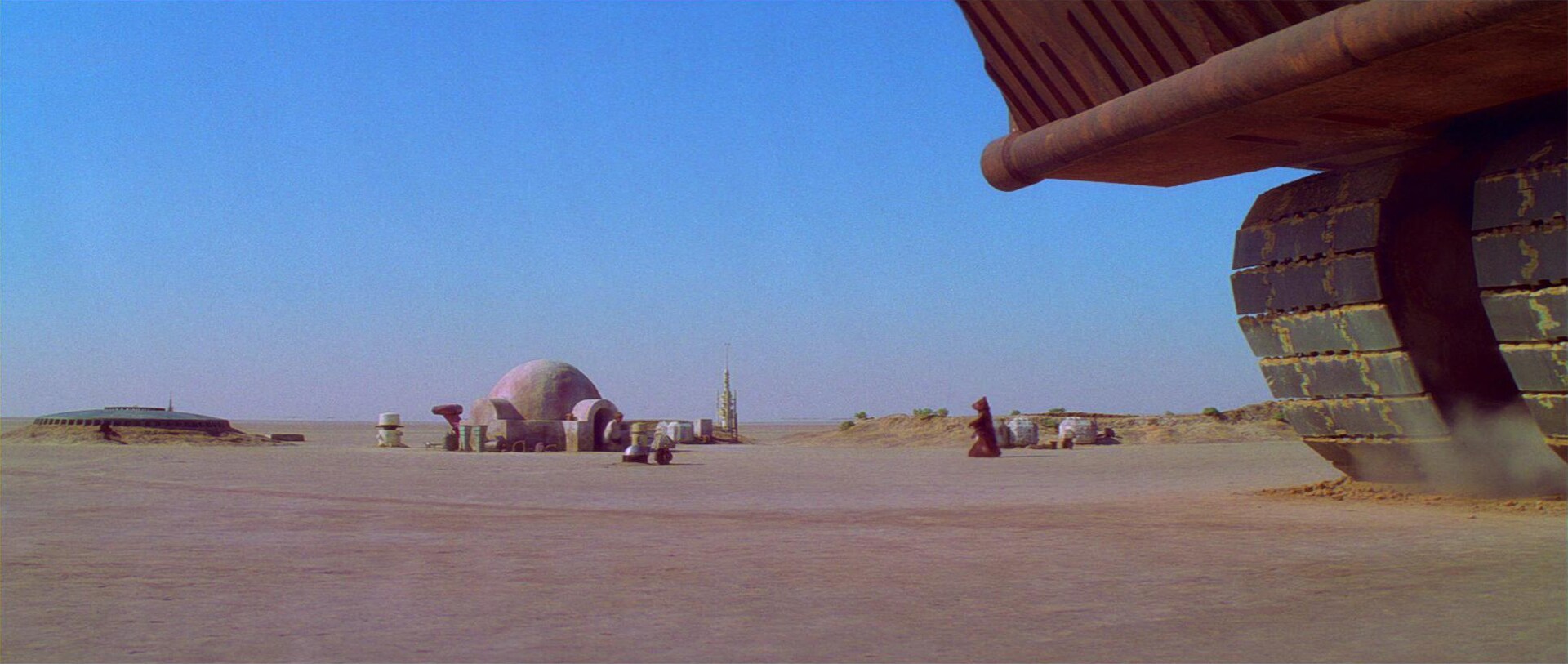
The first shot captured by A camera established the view of the Lars Homestead and Jawa sandcrawler when Uncle Owen and Luke Skywalker meet with the Jawa merchant.

The B camera, an Arriflex with a 180mm lens, was operated by Geoff Glover capturing a tighter view of the Homestead’s “igloo,” with the main characters in the foreground. It was Brown, playing Uncle Owen, who spoke the first line of dialogue in a Star Wars production, a gruff and matter-of-fact, “Alright, fine, let’s go,” in response to the eager Jawa merchant (Jack Purvis).
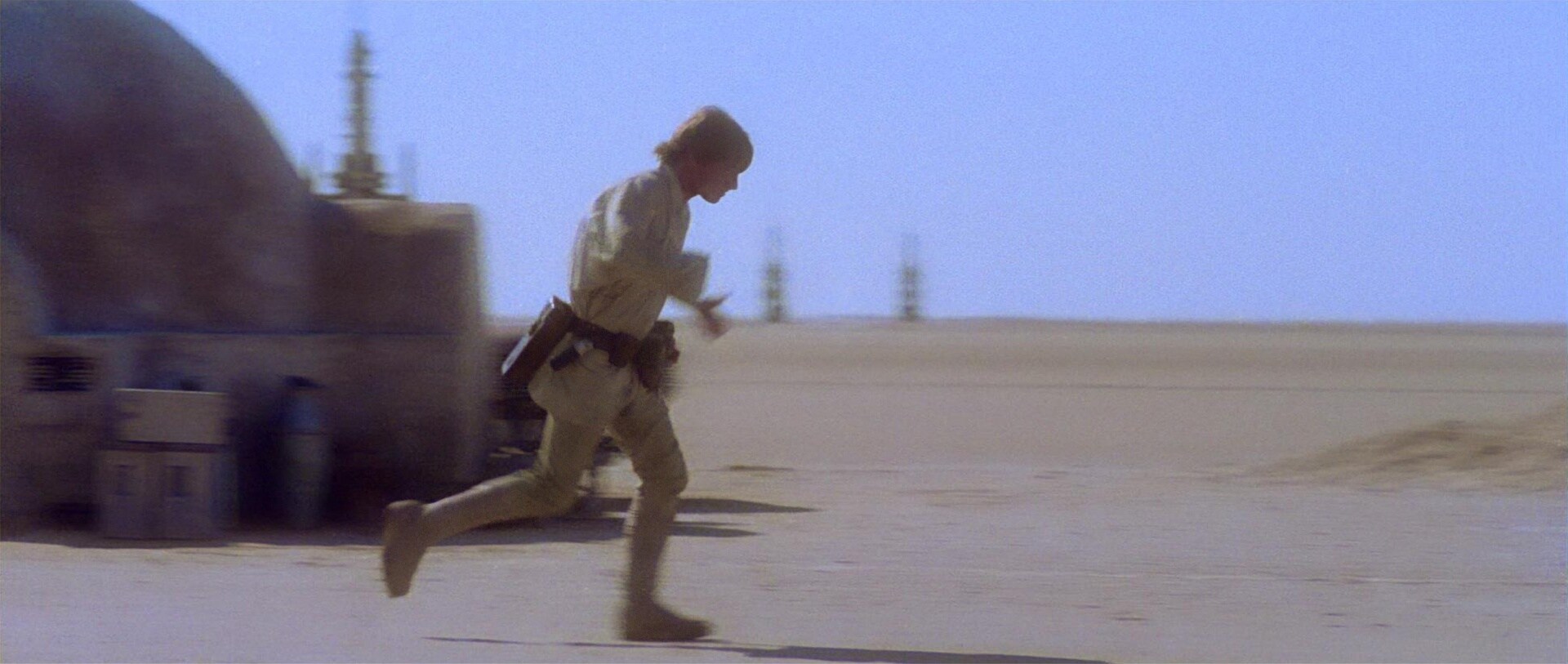
The first captured by B camera – simultaneously with the angle above – followed Luke’s path to the nearby rim after he hears a call from Aunt Beru.

In the final cut of the film, the subsequent shot of Aunt Beru, seen down within the troglodytic hole that was the Lars’ dwelling, and that of Luke seen up above at the hole’s rim, was captured at an entirely different Tunisian location at a later date in the shoot. But during that first set-up on March 22, B camera held with actor Mark Hamill as he went up the small rise at the Nefta location, pretending to look down at Beru actor Shelagh Fraser, and calling, “Doesn’t look like we have much of a choice, but I’ll remind him.” This bit of unused performance was Hamill’s first recorded line of dialogue.
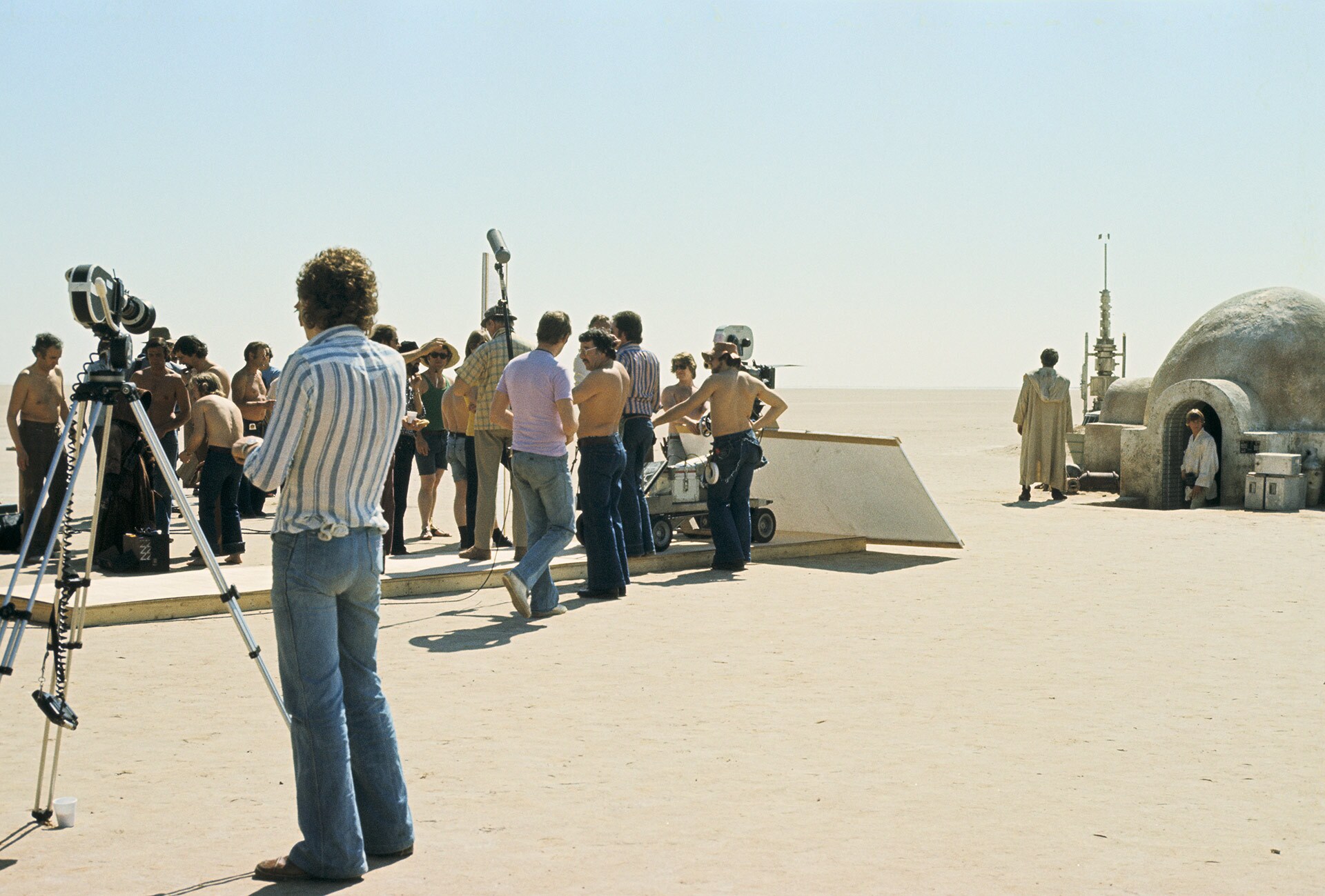
The crew readies an additional medium shot for Uncle Owen and Luke’s meeting with the Jawa merchant.

Droid Difficulties

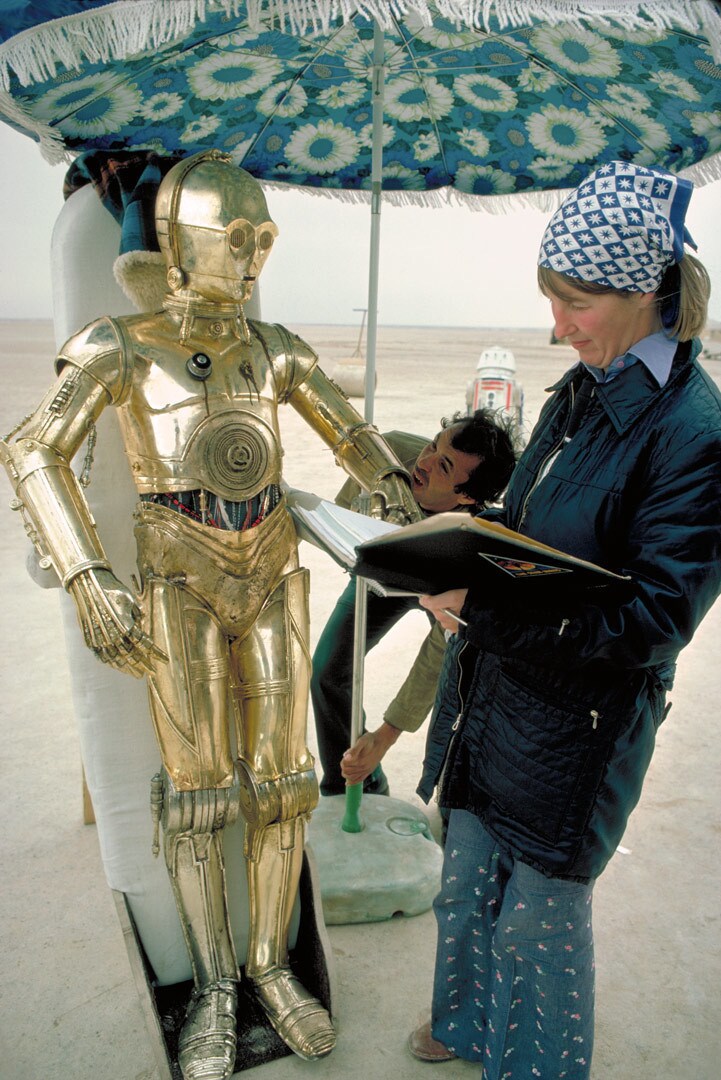
Actor Anthony Daniels takes a standing break in his C-3PO costume while script supervisor Ann Skinner (right) reviews dialogue.

Moving quickly, the production team captured two takes before the crew moved on to other shots. B camera grabbed inserts of droids being unloaded from the sandcrawler, including ones described as “black robot” (later dubbed R1-G4) and “umbrella robot” (likewise dubbed WED-15 Septoid Treadwell) in the day’s continuity report, completed by script supervisor Ann Skinner. A camera grabbed another angle of Owen and Luke’s first interaction with the lead Jawa, a medium shot briefly used in the final cut. Then came Owen’s interaction with C-3PO, initially covered in a long master shot and then subsequently with over the shoulder angles for the human and droid respectively.

Threepio’s interaction with Owen was actor Anthony Daniels’ first opportunity to play a scene. He was admittedly in a fair amount of physical pain that day. He hadn’t slept the night before and had worn the complete Threepio costume only once during a brief test back in England. The suit had been hastily finished and proved to be very uncomfortable and difficult to walk in. During the first take of his initial close-up, a misplaced wire hung off the back, and at other moments, the droid’s eyes failed to illuminate. It would be the first and last time that Daniels wore the full costume for an entire day of shooting.
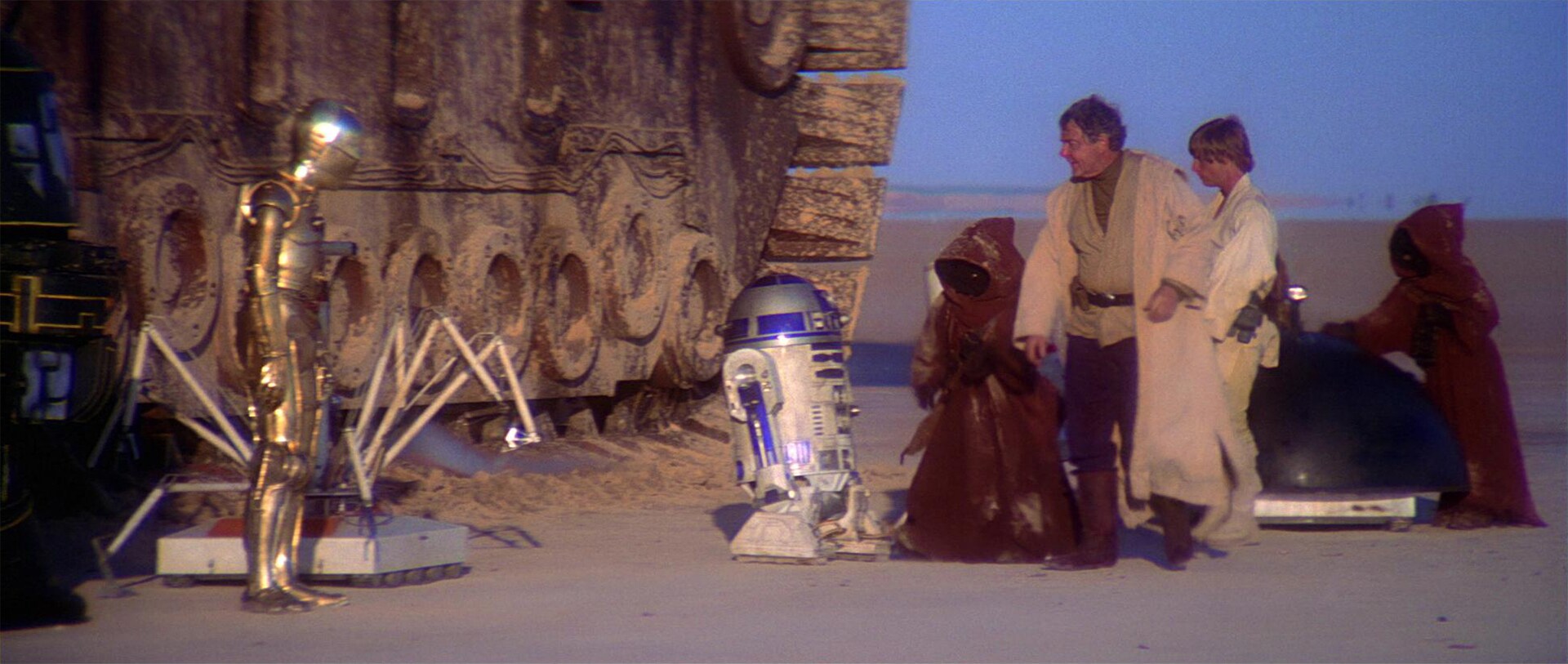
Uncle Owen reviews the droids for sale.

If Threepio’s components presented a wardrobe challenge, the other droids on set posed even greater technical difficulties. Many repeatedly crashed into each other. R2-D2’s head fell off multiple times. Actor Kenny Baker, performing inside Artoo, struggled to hide his legs while shaking the droid.
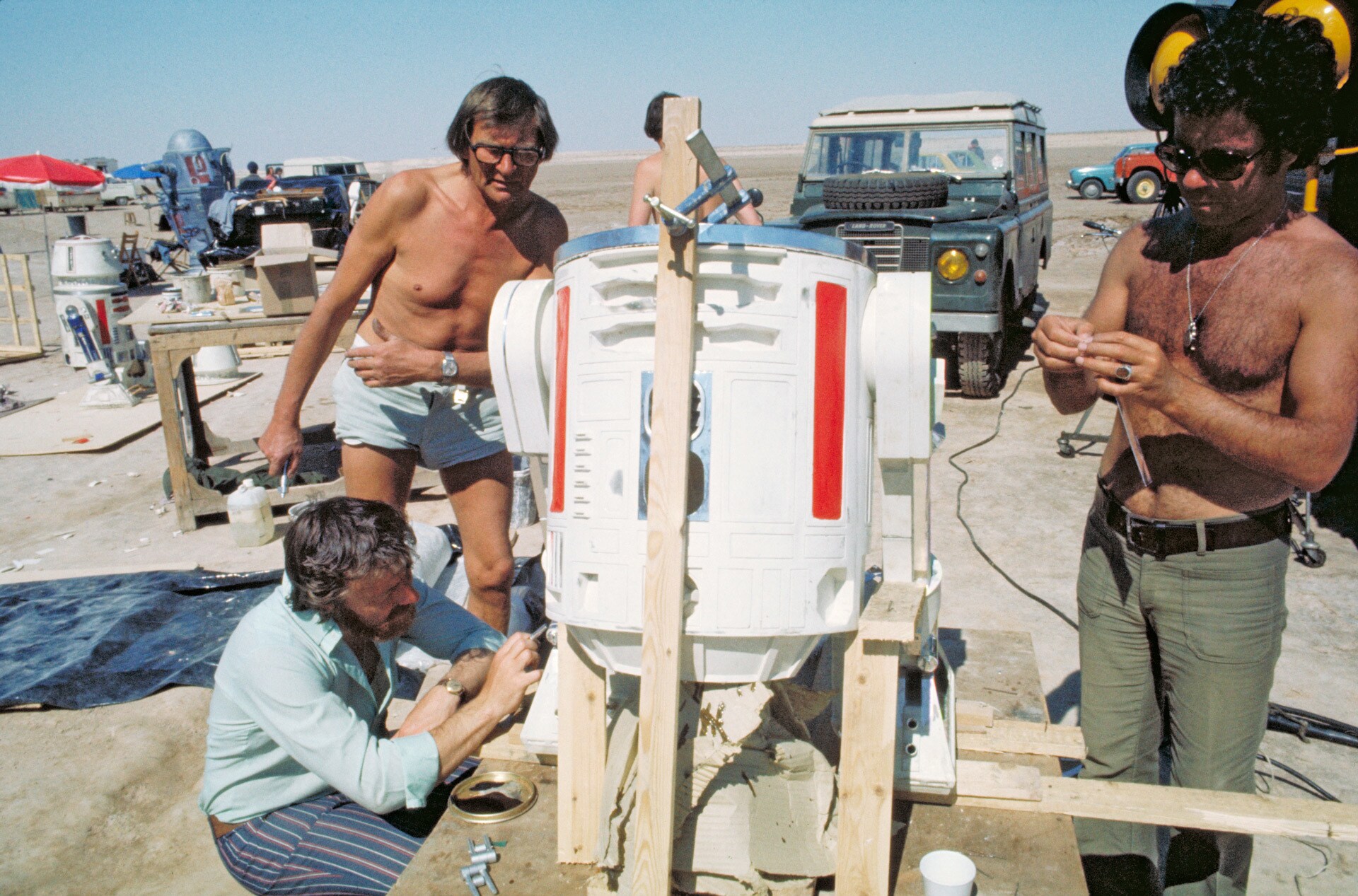
Crew members work hastily to prepare an astromech droid for R5-D4’s small-scale explosion thanks to a “bad motivator.”

Bad Motivator | Star Wars: A New Hope

Bad Motivator

Luke nearly misses the opportunity to meet the trusty Artoo when his uncle purchases a different astromech from the Jawas. When the red astromech blows a motivator, though, Luke convinces his uncle to pick up the little blue unit, R2-D2.

Worse still were the issues with what was called the “redhead unit,” later dubbed R5-D4. The astromech with a canonically “bad motivator” was indeed functioning poorly. Expected to roll towards Luke and Threepio before its head suddenly explodes, the crew was unable to properly rig the effect because all of the mechanical controls were located inside the head itself. They quickly improvised, repainting another astromech body with the appropriate red trim, pulling it invisibly with piano wire, and rigging the head to blow. Many of these technical problems were a result of the crew’s hurried final stretch of preparations after 20th Century Fox’s hesitant pre-production moratorium in late 1975 — a result of their inability to cement a deal with Lucasfilm — causing severe scheduling disruptions.

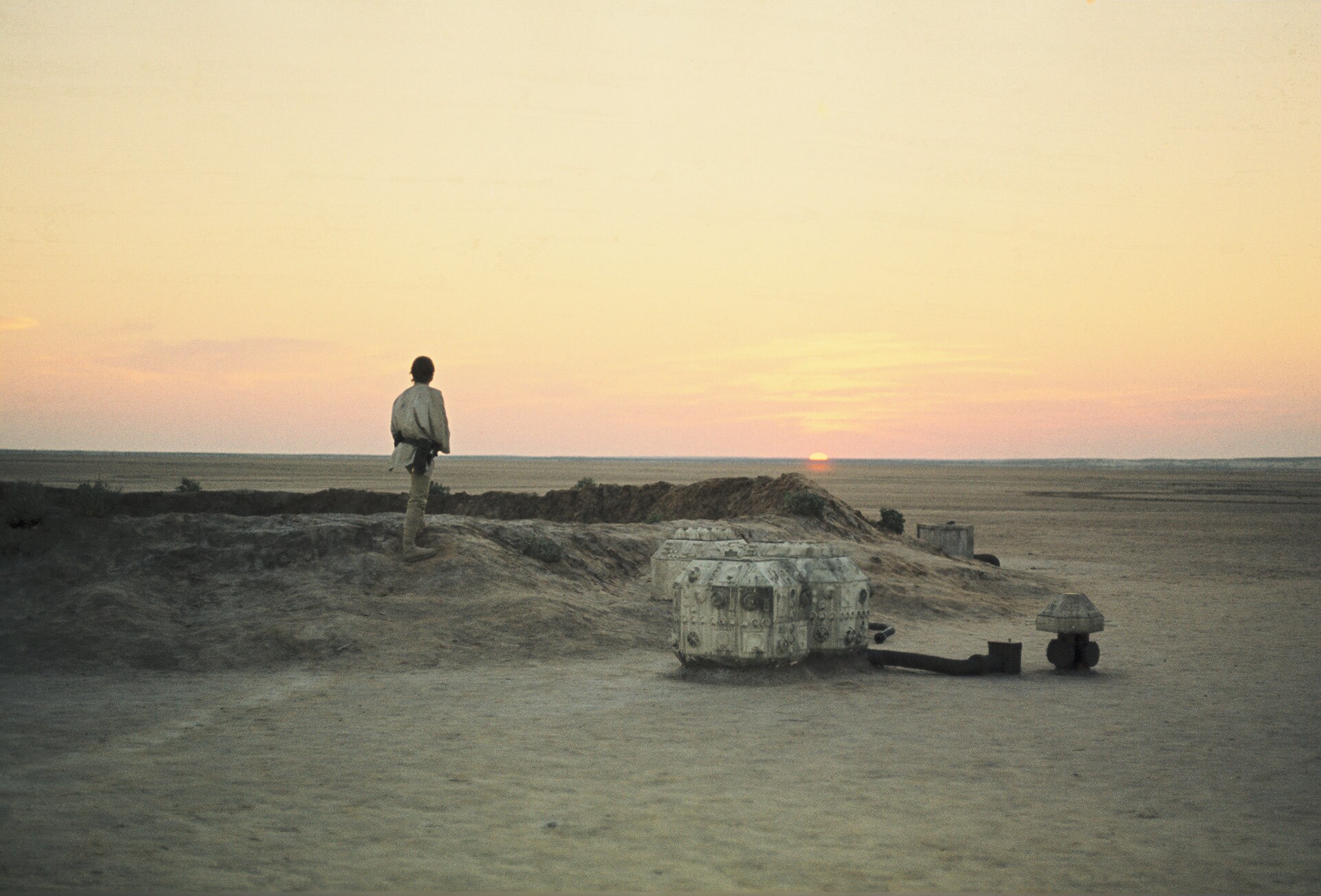
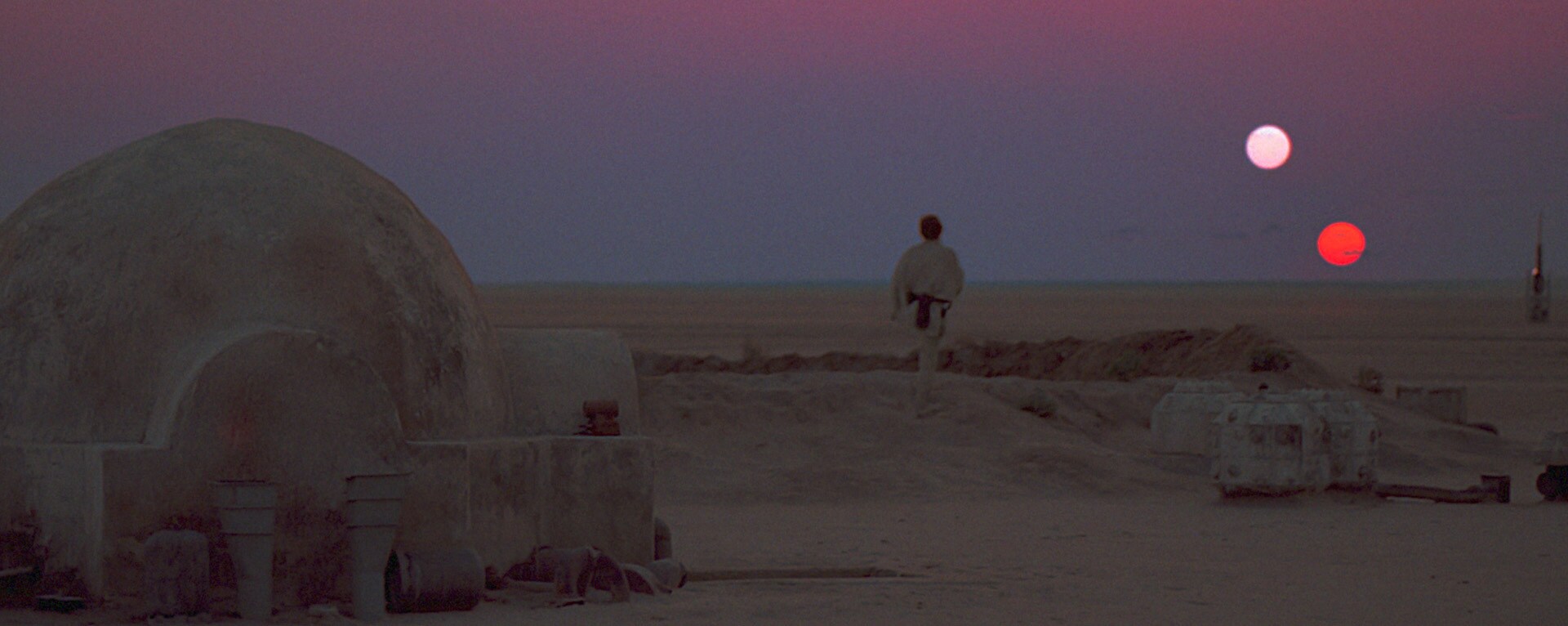
Luke looks out at the twin suns on Tatooine.

A Fateful Sunset

After many shots from the droid sale were completed, the crew made what would be their first of multiple attempts at Scene 29, in which Luke gazes at the fateful twin sunset. Ultimately, none of the March 22 sunset takes were used in the film. According to J.W. Rinzler in his seminal book, The Making of Star Wars, the weather was uncooperative. Scene 29 wasn’t completed until a week later.

The shots that were attempted on March 22, however, are surprisingly different from those depicted in the final cut, newly revealed in continuity reports from the production. One view looked towards the igloo home, away from the setting sun, as Luke emerges. The white vaporator boxes are at the bottom of frame, and Luke stops near them, placing his hand on one as he gazes past the camera at the twin suns. An alternate, improvised take was then captured by Gil Taylor himself, the camera positioned behind Luke, towards the sunset, but with the character still in frame.

The initial attempt to capture Luke’s view of the twin sunset included a reverse angle of the character standing at the white vaporator boxes seen at right.

The March 22 continuity report for Scene 29’s twin sunset also includes a note that “there is a matte shot to go into this sequence – from behind Luke – to matte in the twin suns.” This brief annotation signifies the first visual effects plate ever captured for a Star Wars production, and thus the first ever captured for Industrial Light & Magic, at the time still less than a year old and rapidly building up its visual effects pipeline back in California.

Scene 29 was also notably captured without sound in anticipation of the film’s musical score being added later. Lucas had already met with John Williams a year before in 1975, when the composer agreed to join the production, though by March of 1976, he had yet to formally begin work. Just a week after Star Wars began shooting on March 29 – the same day that the crew finally captured the sunset shots – Williams won his second Oscar for the score of Jaws (1975).

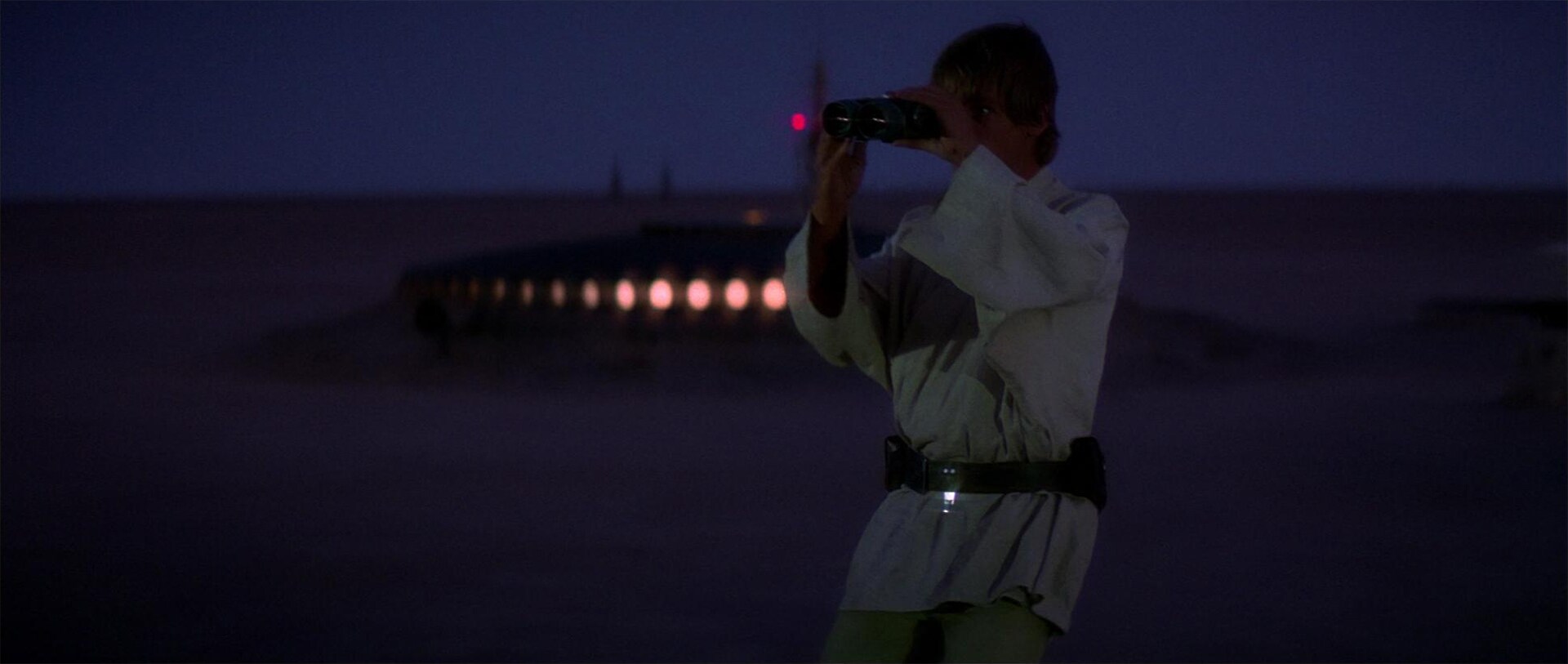
The final shots captured on March 22 involved Luke’s attempt to spot R2-D2 after the astromech has made his escape to find Obi-Wan Kenobi.

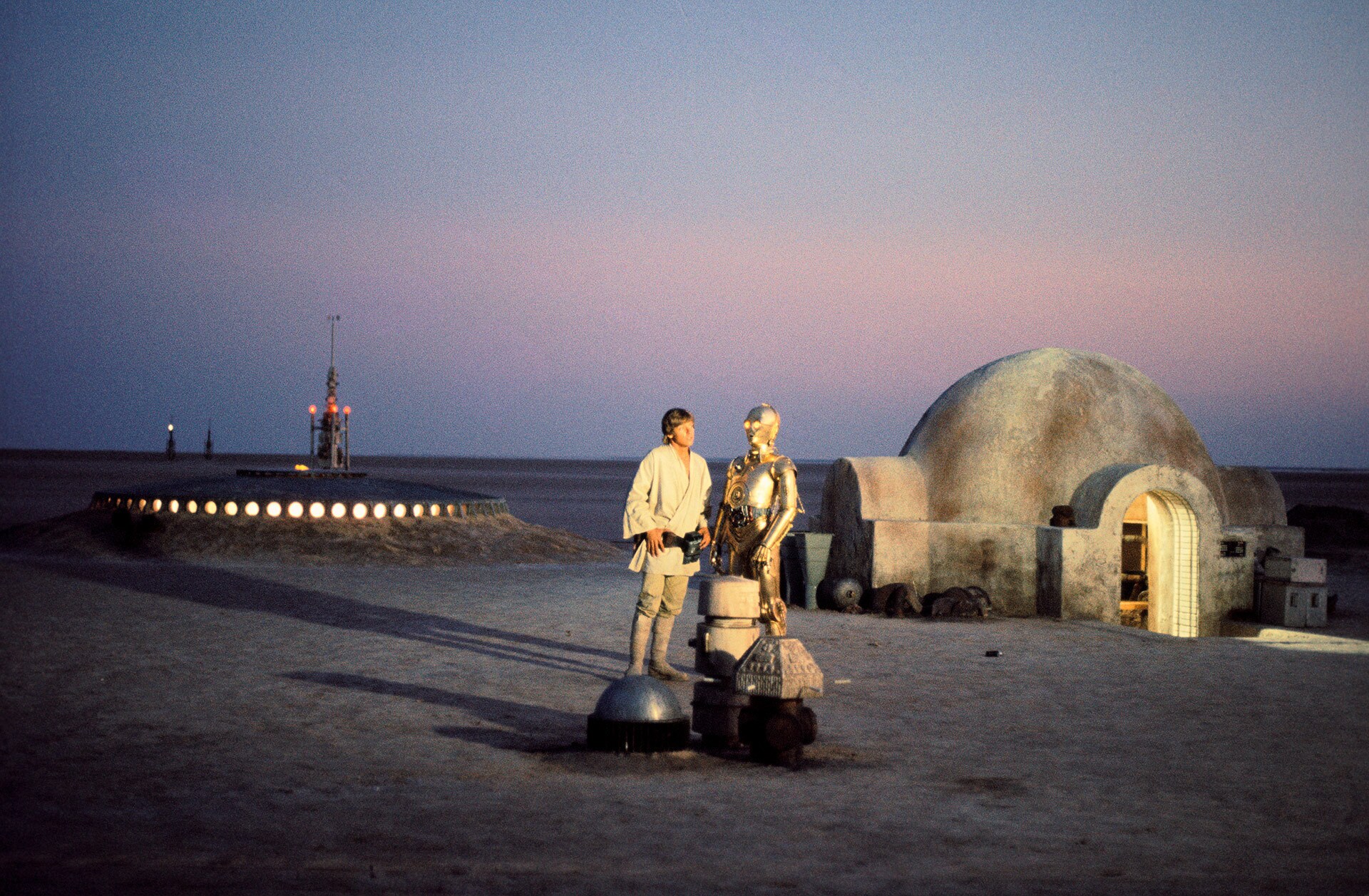
The first day of shooting concluded after dusk with two set-ups for scene B29, when Luke emerges once again from the igloo, macrobinoculars in hand, and tries to spot R2-D2, who has run off sans restraining bolt. C-3PO soon follows and the pair have a brief exchange. “Boy, am I gonna get it,” Luke says. “You know, that little droid is going to cause me a lot of trouble,” to which Threepio replies, “Oh, he excels at that, sir.”

The cast and crew wrapped a little after 7 in the evening. They’d completed 14 set-ups, roughly 34 takes in all, with some two dozen of those considered worthy to print. Belabored with challenges, it was an inauspicious start, and things would get worse before they got better. A once-in-a-generation storm was about to hit the region, plaguing the film’s schedule and logistics, and more difficulties would soon arise back in England.

Story details would change as well. While shooting in Tunisia, Luke’s surname remained “Starkiller.” He wouldn’t officially be renamed “Skywalker” until a month later. George Lucas also made a significant decision while in North Africa: to kill Obi-Wan Kenobi near the end of the film as a means to elevate the drama.

Dusk falls on the first day of production on Star Wars: A New Hope.

But as many would attest, in spite of the production’s numerous obstacles, Lucas remained calm in the face of adversity, quietly devoted to crafting a mythic tale for a new generation. He knew what he was making and how to achieve it. It was only a matter of directing the people and resources to make it possible.

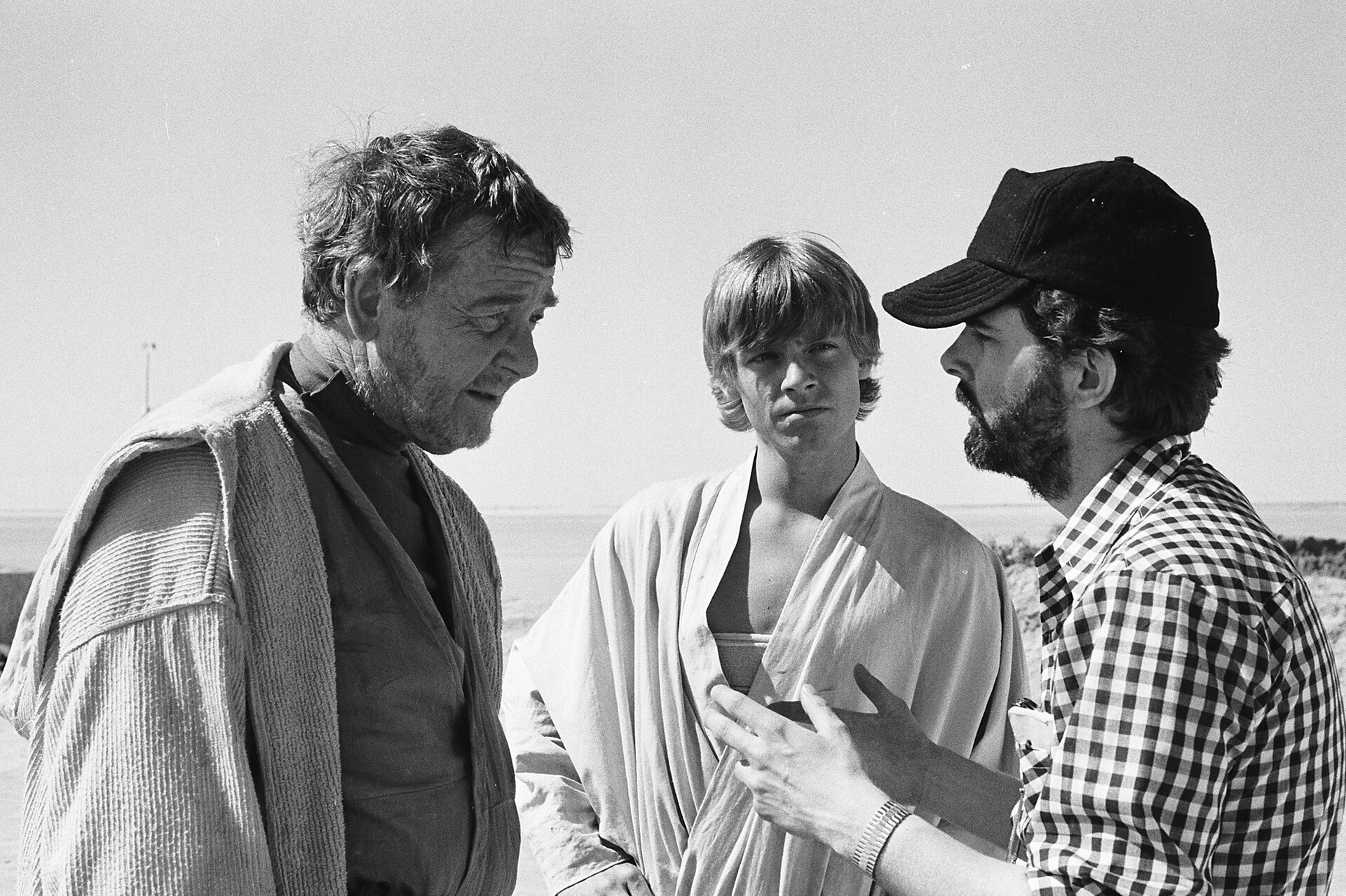
George Lucas (right) confers with Phil Brown (left) and Mark Hamill on the first day of shooting.

As Lucas had told the film’s novelization author, Alan Dean Foster, a few months before the start of shooting, “Basically it’s a fairy tale…. Star Wars is built on top of many things that came before. This film is a compilation of all those dreams, using them as history to create a new dream.”

Watch Star Wars on the big screen when it returns to theaters for the 50th anniversary February 19, 2027.

With sincerest thanks to Lucasfilm’s film and image archivists for their generous research support.

Star Wars Episode IV: A New Hope (1977)

Related News + Features

  • {:title=>"Lucasfilm", :url=>"https://www.starwars.com/news/category/lucasfilm"} {:title=>"Films", :url=>"https://www.starwars.com/news/category/films"}

    Star Wars Year in Review 2025

    December 22, 2025

    December 22, 2025

    Dec 22

  • {:title=>"Lucasfilm", :url=>"https://www.starwars.com/news/category/lucasfilm"} {:title=>"Films", :url=>"https://www.starwars.com/news/category/films"}

    Star Wars Returns to Theaters for 50th Anniversary - Update

    December 5, 2025

    December 5, 2025

    Dec 5

  • {:title=>"Lucasfilm", :url=>"https://www.starwars.com/news/category/lucasfilm"} {:title=>"Series", :url=>"https://www.starwars.com/news/category/series"}

    Maul’s Most Devious Moments

    March 18, 2026

    March 18, 2026

    Mar 18

  • {:title=>"Lucasfilm", :url=>"https://www.starwars.com/news/category/lucasfilm"} {:title=>"Series", :url=>"https://www.starwars.com/news/category/series"}

    Star Wars: Maul – Shadow Lord Teaser Trailer and First Poster Arrive

    January 22, 2026

    January 22, 2026

    Jan 22

  • {:title=>"Lucasfilm", :url=>"https://www.starwars.com/news/category/lucasfilm"} {:title=>"Series", :url=>"https://www.starwars.com/news/category/series"}

    Celebrate Lucasfilm Animation’s 20th Anniversary With This Who’s Who Poster

    January 21, 2026

    January 21, 2026

    Jan 21

  • {:title=>"Lucasfilm", :url=>"https://www.starwars.com/news/category/lucasfilm"} {:title=>"Films", :url=>"https://www.starwars.com/news/category/films"}

    Star Wars Year in Review 2025

    December 22, 2025

    December 22, 2025

    Dec 22

  • {:title=>"Lucasfilm", :url=>"https://www.starwars.com/news/category/lucasfilm"} {:title=>"Films", :url=>"https://www.starwars.com/news/category/films"}

    Star Wars Returns to Theaters for 50th Anniversary - Update

    December 5, 2025

    December 5, 2025

    Dec 5

  • {:title=>"Lucasfilm", :url=>"https://www.starwars.com/news/category/lucasfilm"} {:title=>"Disney+", :url=>"https://www.starwars.com/news/category/disney+"}

    Watch the Star Wars: Young Jedi Adventures Season 3 Trailer with Your Younglings

    November 19, 2025

    November 19, 2025

    Nov 19

  • More From Star Wars:
    • TikTok
    • Instagram
    • Twitter
    • Facebook
    • Youtube
    • SWKids
    • Terms of Use
    • Additional Content Information
    • Privacy Policy
    • Children's Online Privacy Policy
    • Your US State Privacy Rights
    • Disney Store | Star Wars
    • Star Wars Helpdesk
    • Interest-Based Ads
    • Do Not Sell or Share My Personal Information

    TM & © Lucasfilm Ltd. All Rights Reserved