[ Welcome ] [ What's New ] [ The Movies ] [ Beyond the Movies ] [ Gaming ] [ Community ] [ Kids ] [ Shop ] [ Hyperspace ] [ Starwars.com ]
[ Starwars.com ]

[ Skywalker, Luke ]
Skywalker, Luke
The path of a Jedi is often difficult, filled with conflict and pain...
[ Read More ]
Feature: Lucasfilm Fan Club Magazine #21 Online Supplement
Feature: Lucasfilm Fan Club Magazine #22 Online Supplement
Feature: starwars.com at Celebration III
Feature: starwars.com @ Celebration II
 
[ Episode IV ]

An Excerpt from Alter Ego Magazine
Ed Summer & George Lucas
Charley Lippincott (&, Incidentally, Ralph McQuarrie)
Stan Lee (& Maybe Alec Guinness)
Howard Chaykin and Ed Shukin
Howard Chaykin (Again),Steve Leialoha, & Others
"That Legendary Screening"
Chaykin, Leialoha, and Gafford Remember
Star Wars: The Comic Book That Saved Marvel!
June 01, 2007

"That Legendary Screening"

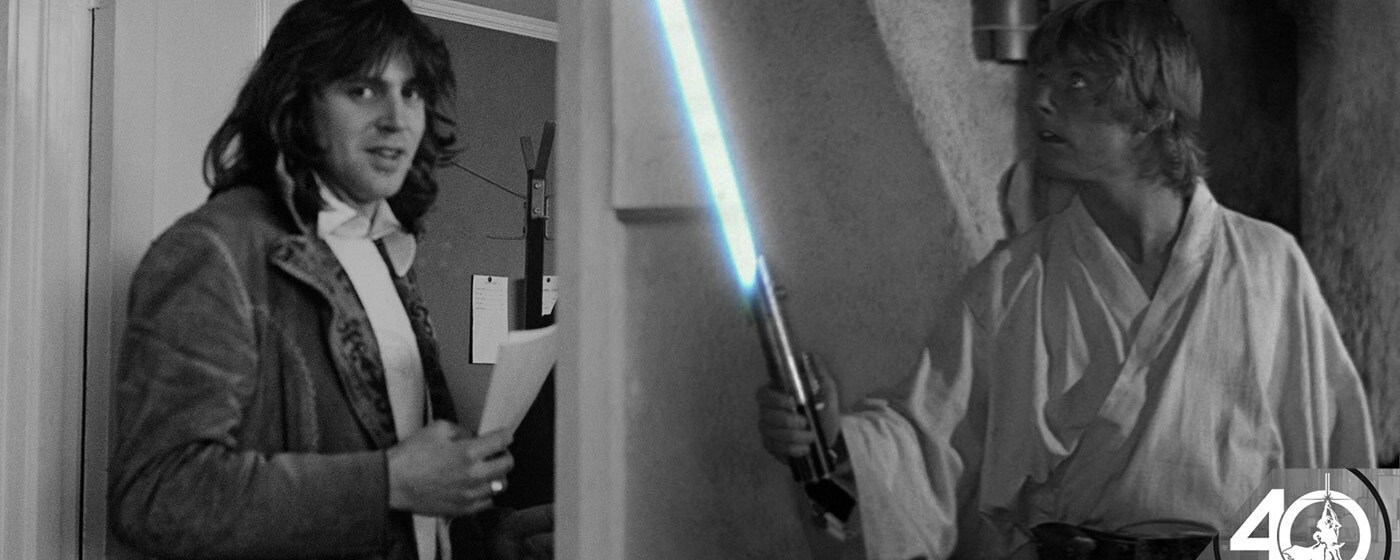
My favorite memory of those days, though, was the time -- circa February of '77 (was it the same event Steve Leialoha says he attended on Valentine's Day? See sidebar above), three months before the film's release -- when Howard Chaykin and I (possibly with Charley) were flown up north to George's spread in San Anselmo, California, to see a rough cut of the film. We landed at some small airport and were transported to George's by limousine, probably a stretch job -- well, we were in the limo, anyway. It was mainly there to carry Alan Ladd, Jr., the chief of 20th at the time, and maybe another exec or two. I only learned later how supportive Ladd had been of Star Wars from the start -- and that his job was basically on the line because of it. Uncertain what to say to a studio head who was also the son of the star of Shane and many other movies I'd admired, I opined that I believed Star Wars would be a big hit. A long-suffering look came over Ladd's face, and he muttered, "We sure hope so," or a few other words to that effect, and then said virtually nothing more during the ride. Later, I would learn that he was noted for his taciturnity. "When he says hello," someone wrote, "he thinks he's holding up his end of the conversation." Well, his old man had been the strong silent type, too, and it had served him well.

Soon, Howard and I were deposited, along with Ladd and the others, at George's secluded estate, which was quite a spread. The money from American Graffiti must have been very good, indeed! There was a sizable screening room attached to the main house for viewing movies; and George's then-wife, herself a professional film editor, had her own editing studio there, as well. Howard and I were really just present as an afterthought, in case it would help the comic book (and thus the film) in some undescribed way. George was primarily concerned with showing the rough cut to several of his director friends, who had come separately. I recall meeting Phil Kaufman, who had recently directed The Outlaw Josey Wales and would later helm Invasion of the Body Snatchers, The Right Stuff, et al. Maybe Steven Spielberg was there, too, for all I know. No particular attempt was made to introduce us to the film people.

By some sort of silent natural selection, George and his fellow moviemakers (directors and executives) sat in a clump in one section of the screening room, while I seem to recall Howard and me winding up in the front row, and the showing of the rough cut began.

A rough cut, of course, is basically a movie as a work in progress, either minus a music score or more often with a temporary one in place to set the mood. Since this one included a few, but not that many, special effects, this rough cut of Star Wars was a very odd film to watch, indeed.

[ Star Wars: The Comic Book That Saved Marvel! ] It opened with a "crawl" of copy meant to suggest the old 1930s Flash Gordon movie serials which had so influenced George. But this was not the crawl with which much of the world would soon become familiar, with its "Long ago, in a galaxy far, far away" lead-in. Rather, the crawl consisted of totally different wording relating the film's backstory. If you want to know what it said, you'll have to pick up a vintage copy of Marvel's Star Wars #1, since the typeset captions there were taken verbatim from that original crawl, which was in the screenplay from which Howard and I worked. (Apparently, George would have last-minute thoughts and change it just before the premiere. In fact, one ILM worker told me jokingly around that time that the rumor was that, on opening night, George would probably be up in the projection booth at Mann's Chinese, pasting into place some last bit of film!)

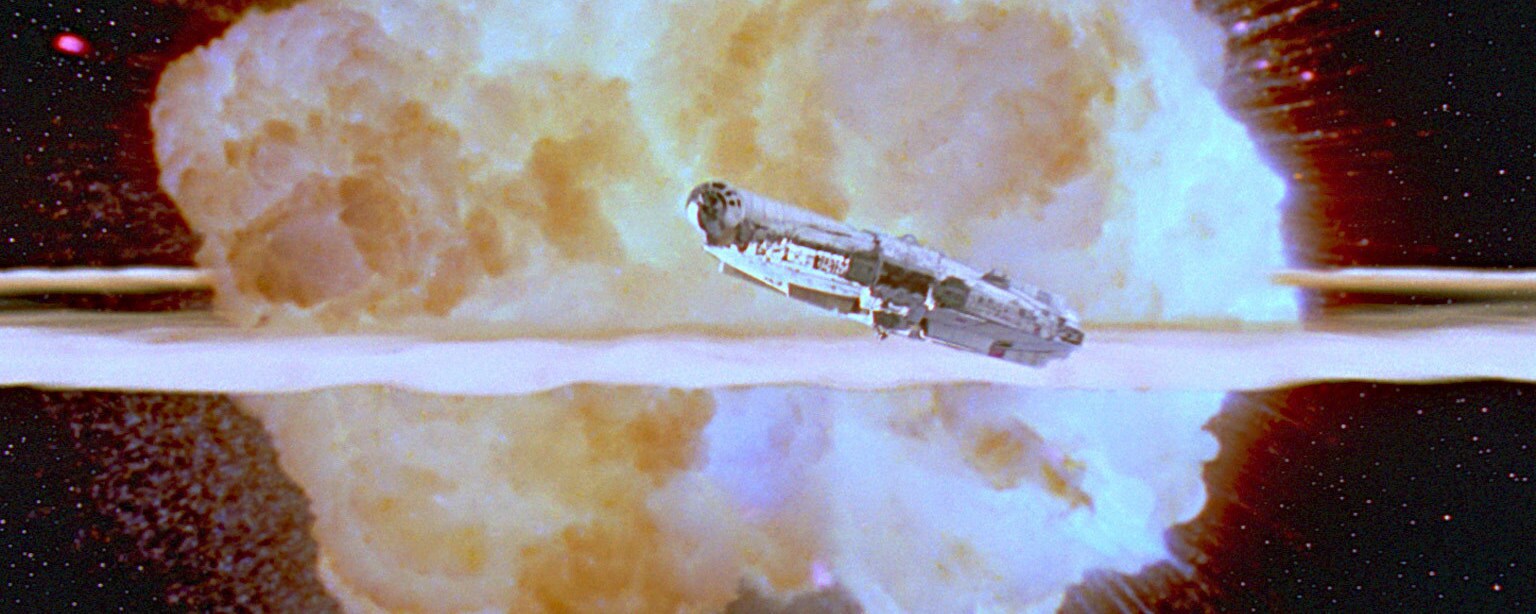
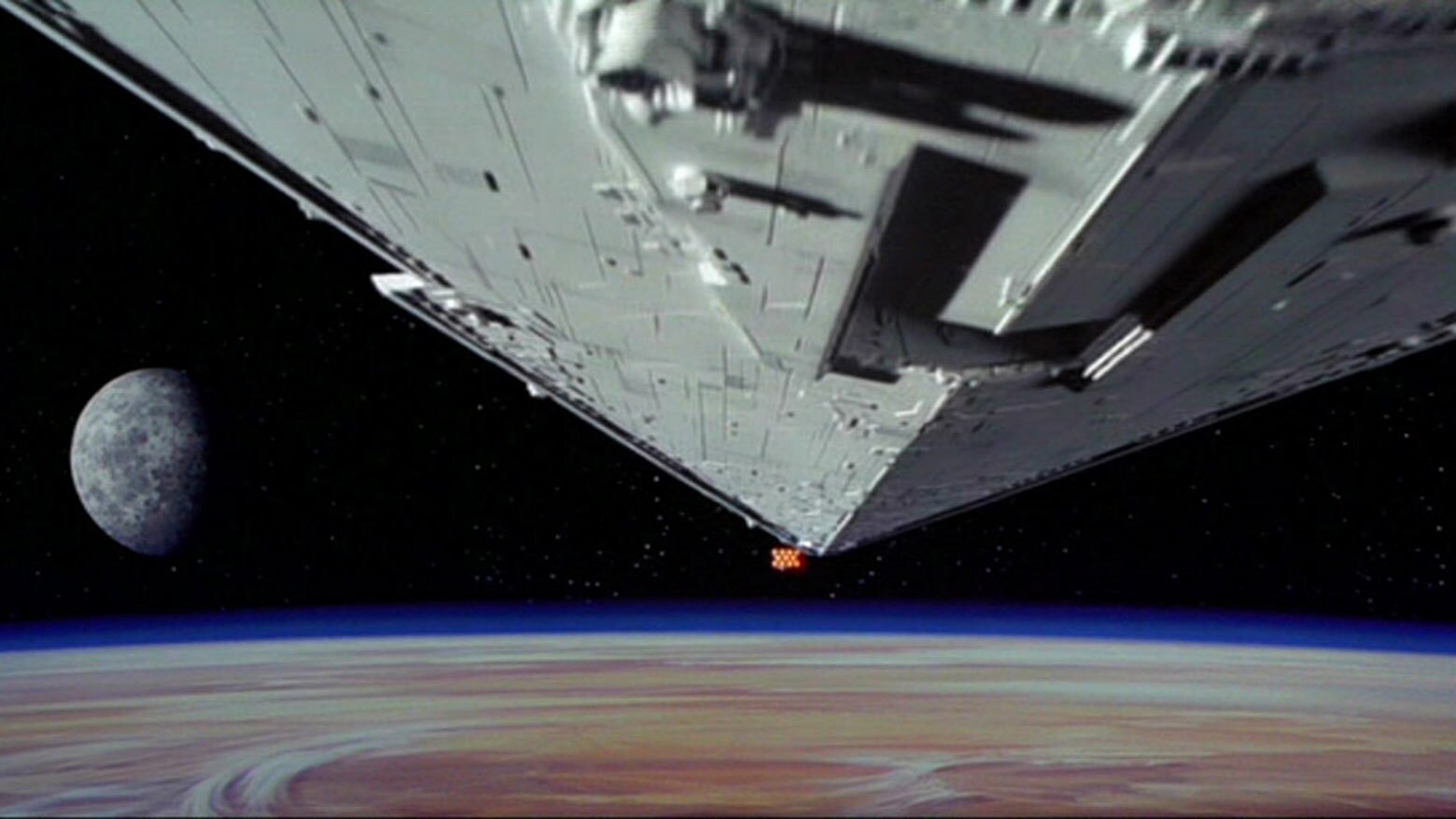
Then in came the spaceships. Even in that rough cut and on a relatively small screen, it was an impressive opening, and I was only moderately surprised a few months later at Mann's Chinese when I sat in a packed, very early audience and heard the shocked gasp of the audience when first the Little Ship came in, emerging at the top of the screen -- then to be followed... and followed... and followed... by the Big Ship. It was an inspired beginning, and got the audience in a receptive mood for all that followed.

Next came the fight aboard the smaller ship -- Stormtroopers vs. Rebels. But no deadly rays were seen zipping back and forth across the screen that day in San Anselmo. Just the brief flicker of hand-drawn arrows on the film, coming out of the barrels of weapons, to show where the special effects would be added later. A humorous effect, at this point. Still, with imagination, you could figure out what the finished sequence might look like.

Soon, Darth Vader strode in and began to speak -- with a thick Scottish accent, emerging from under that black full-face helmet, and mostly unintelligible for both the above reasons. This was actor David Prowse's own muffled voice, of course, some time before the sepulchral tones of James Earl Jones were laid in.

The movie went on. I noted with chagrin that one scene from the early pages of the screenplay -- between Luke (whose last name was now definitely Skywalker) and some chums on Tatooine (one of them named Biggs)-- had been cut, even though I was well aware that a four-color version of it was even then being printed in the first issue of the comic. (Naturally, a few irate fans would castigate us later for inserting things into "George's movie." And, while I dismissed them as know-nothings, it's true that the omission of that short scene undercut one aspect of the climax, for Biggs is one of the Rebel pilots who dies attacking the Death Star; his death would've meant much more if we'd seen his personal relationship with Luke earlier.)

As I said before, some special effects were already present in this rough cut; more were not. When the Millennium Falcon took off from Tatooine, bystanders looked up into the sky and pointed -- at nothing. That sort of thing.

But the real fun occurred when Luke and Han began to take potshots at pursuing TIE fighters during their escape from the Death Star in mid-picture. Luke would be shown "firing away" from the tail-gunner bubble, then the film would cut away to black-&-white inserts of -- aerial dogfights from World War II! (Well, either they were dogfights between Allied and Axis planes, or maybe they were, more logically, footage shot from the tail-guns of US bombers being attacked by enemy fighters.) Then back to Han Solo, blasting away -- cut to another Zero or Messerschmitt going down in flames. A surreal experience, definitely.

Still, by the time the rough cut ended, I was convinced that, if the special effects wound up doing justice to what I'd seen, it would be a very good film. A hit? Well, that depended on the vagaries of the moviegoing audience, and was beyond any man's power to fathom in advance, be it mine or George Lucas' or Alan Ladd, Jr.'s.

When the lights came up, everybody applauded -- but that was only to be expected. If the movie had been an obvious bomb-in-the-making, the directors and execs would probably still have slammed their hands together. There followed a seeming eternity of raw footage of what looked like Aurora model kits exploding, in test shots, accompanied by a genial discussion of how there would be loud BOOMs accompanying them, even though everyone knew there was no sound in outer space.

After all, this was, as George had always called it, a space fantasy.

It seemed to me, then and later during the inevitable buffet, that this was a group of filmmakers who really liked George, liked his movie, and wanted both to succeed. George himself was, as might be expected, affable but perhaps a tad nervous. Howard and I were soon bundled back to L.A.

It was only in 2006, while being interviewed by the author of a forthcoming book on Star Wars collectibles [Steve Sansweet, The Star Wars Vault] who himself owns one of the biggest collections around, that I learned the foregoing event was referred to by cognoscenti as "that legendary screening." I can see why. Much as I like the finished film, I'd gladly trade my copy of it for one of that rough cut, with Luke and Han shooting it out with the Axis!

For more of Roy Thomas' reflections on Marvel's Star Wars comic, get Alter Ego #68, on sale now at www.twomorrows.com.


[ Archives ] [ Discuss This ] [ Email This ]

© Lucasfilm . All rights reserved. | Terms of Use | Privacy Policy | Business inquiries