![[ ILM ]](/episode-iv/bts/article/f19970811/img/all.jpg)
A variety of positions contribute to making a computer model
Star Wars computer-generated (CG) creatures begin their lives in the Art Department. Here among traditional artists working in a wide variety of media, sketched concepts get refined to approved drawings, and rough sculptures become final maquettes. All these works are eventually transferred to the people at Industrial Light & Magic (ILM) for the creation of the computerized version of the creature. Everything from designs of the skeletal structure to skin texture is important reference for the CG people, and all of it is used in translating the artist's vision to the world of computer modeling.
Within the mysterious hallways of ILM, powerful computers hum and process millions of calculations at the direction of the small army of technicians assembled for the work. Outside documentaries often give one the impression that these people create a CG dewback by "hitting the dewback button" on their keyboard. The fact is that a variety of distinct types of artists contribute to the creation of the fantastically complex mathematical model that results in the illusion of a moving, living creature. Many of them use metaphorical terminology, making use of descriptive phrases from the artist's studio or the film editor's room - so we still speak of sculpting, or compositing images together, knowing that it's all taking place in the computer and on the screen.
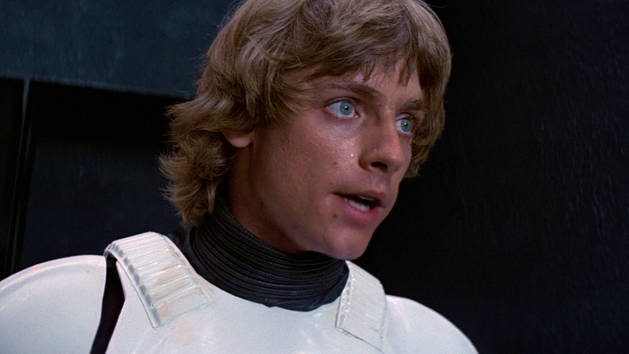
Typically, a CG creature is made to be combined with a live-action shot, which will include an environment (like sand dunes) and characters (like stormtroopers). Creating a CG creature is only part of the job - the creature must be made to walk in a way that matches the live-action plate shot, and then combined with the plate in a seamless fashion.
The CG Modelers build three-dimensional wire-frame models in the computer. These models include hard-surface models (industrial and architectural design), digital sets and CG creatures. In many cases the modelers must build several versions of an object or creature to achieve different desired effects. In the case of creatures, modelers must build multiple facial shapes, often up to 40 or 60 different facial expressions for any given character, especially if it talks. After a model is built, the modeler will continue to work closely with the animators to make modifications due to the complexity and varying demands of any given shot.
A Match Mover makes sure that the virtual environment in the computer matches the real environment filmed for a scene. They also make sure that any camera moves (like pans or zooms) in a live action shoot are carefully matched by the computer's virtual camera. The lead match mover usually goes on location with a Plate Shot crew to get the necessary information for reconstructing the 3-D environment in the computer. A match mover might use reference points specially placed in a scene for reference and alignment in the creation of the CG environment - for the dewback scene, tennis balls in the sand, laid out in a regular grid, provided secure reference points for the match movers.
When a CG creature or element is added to a the live-action plate, it is placed on top of the existing image, which will make it appear to be in front of everything else unless special steps are taken. Digital Rotoscope Artists make sure that a CG lizard in the background doesn't overlap a stormtrooper in the foreground. They do this by outlining foreground objects (like stormtroopers) in the live-action film, creating an articulate matte. This moving silhouette of the stormtrooper keeps the computer from generating CG objects in that area, making the dewback appear to walk behind the human figure. The Rotoscope artists are also the people who "perform background repair" and conveniently erase things like tennis balls in the sand.
Viewpaint Artists, meanwhile, are enhancing the creature model by giving it colors and textures. They take a complex but colorless form from the modelers and transform it from something that appears like plastic to something that may appear wrinkled, hairy, or in the case of a dewback, scaly. Their work, based on color paintings from the Art Department artists, will make the CG creature sport a rich variety of hues. Combined with the textures, the realistic colors turn the CG model into a convincing imitation of reality.
The creature may look great now, but he's still got to move. That requires a whole additional set of skills. A Character Animator takes the CG creature model and gives it motion using a combination of complex commercially-available software and ILM's proprietary software. Convincing, life-like motion cannot be generated by a computer alone, however, and giving the creature realistic movement takes the artistry of a human animator. These people often come from a background in traditional hand-drawn "cell" (or cartoon) animation, where they learned the subtleties of creating the illusion of living movement. The same expertise is applied to the CG creature using the tools of the movement software. Effects Animators work on the less-complex motion of objects that are not living creatures, such as vehicles or Imperial landing craft.
The creature's moving, and he's got a place to fit in the film, but without virtual lighting he'll never look right. A Technical Director is responsible for the look and lighting of computer generated objects. Light quality and light direction, diffusion, and other factors must be involved to match the CG creature to the live-action environment. A dewback far away on the horizon would look completely wrong if it were as sharp and bright as a Dewback in the foreground. Atmospheric haze and the effects of sunlight and ambient light are all taken into account to blend the computer model into the filmed environment of the real world.
The technical director also keeps track of all the separate elements that are created to build a final shot, coordinating the work of the people creating those individual elements. This workwith be linked together with mattes, paintings, and particular effects created or designed by the technical director.
Supervising the overall production is, finally, the CG Supervisor. This person assists with any problems that come up anywhere in the sequence, and provides feedback on the success and development of each stage.
So...when you see a creature like a dewback lumbering across the sand, you see the results of a complex process, the painstaking construction of a virtual reality. Rather than a single powerful button on some sophisticated computer keyboard, it is a team of professionals doing a whole variety of jobs that makes this leap of imagination possible.