[ Welcome ] [ What's New ] [ The Movies ] [ Beyond the Movies ] [ Gaming ] [ Community ] [ Kids ] [ Shop ] [ Hyperspace ] [ Starwars.com ]
[ Starwars.com ]

[ Taa, Orn Free ]
Taa, Orn Free
The obese and indulgent Twi'lek politician...
[ Read More ]
Video: Part 11: P-19
Homing Beacon #40 - Casual Days at the Palace
Homing Beacon #35 - Taun We Speaks
News: Prequel art exhibit tours Japan
 
[ Episode I ]

Practical Creatures
The Challenge of Volume
Behind the Masks: An Interview with Jason Baird
May 15, 2001

Practical Creatures

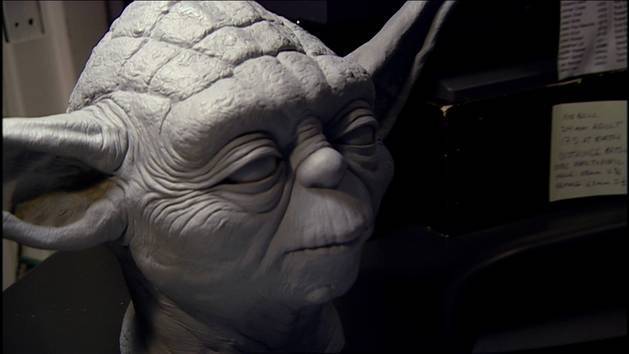
Although many of the alien species to be seen in Episode II will be all-digital creations painstakingly animated and rendered by Industrial Light & Magic, there is still a place for practical creatures. This is where Jason Baird, Live Action Creature Effects Supervisor, enters the Episode II picture.

[ Behind the Masks ] "That involves all the creature heads and paws," explains Baird of his responsibilities, "as well as the animatronic creature heads and also prosthetic characters. It also involves organizing the workshop, and getting the prosthetics ready for on-set use."

A 12-year veteran of the field, Baird ran his own company, crafting various creatures and prosthetic make-up effects for film and television. In March of 2000, Baird was recruited for the latest chapter of the Star Wars saga, with short time to prepare for one of his biggest assignments to date.

"It's a real buzz. It took a long while for it to sink in that we're actually working on Star Wars. It happened so quickly. Only when you see some of the big names on set, with your creatures, does it really hit you," says Baird.

"When we first got the contract to do Star Wars it didn't seem, from the way they were explaining it, like such a huge job," recalls Baird. "But we quickly learned that there was quite a bit of creature and prosthetic stuff that needed to be addressed, more so from the prosthetics side because we inherited many of the Episode I creature heads. When we found that out, we had start building the crew."

Baird's crew grew to 12-15 artists working around the clock to deliver the required make-up effects. "The most challenging thing has been the organization -- getting everything to click and be delivered in working order on time. It's such a short time-span, because we've only really had, after getting set up, five weeks of pre-production. Three of those weeks were trying to get our workshop space into a workable environment. That left us only two weeks to start producing the prosthetic pieces and getting everything ready. It was a really tight timeline, but we managed."

[ Behind the Masks ] Among the featured creations of Baird and his crew are two new heroic Jedi alien characters. One male, one female, both these characters are prosthetic make-up creations with distinctly different builds and profiles. Both have the commanding presence of Jedi Knights and exotic alien looks.

"He's a combination of mottled greens and browns and blacks, so I think it'll look very cool," says Baird, describing the alien color palette. "The female has horns as well as tentacles. She's a combination of grays and whites and red. She should look quite stunning too."

The decision to produce the two alien Jedi came pretty late in pre-production. For the male, Baird and his crew had three weeks to complete the character. "When you're talking about a complicated prosthetic character, that's a pretty short timeline."

Prosthetic make-up creation is a painstaking process. Plaster-like life-casts must be made of the performers slated to play the role, so that the foam latex prosthetic pieces -- called appliances -- will conform perfectly to the contours of a his or her features. The make-up artists then glue the appliances onto the performer, adding additional elements such as teeth, horns or tentacles, and then the whole creation is painted.

Since many different appliances are pieced together for one prosthetic effect, the art of 'seaming' is an important one. "Once you get your foam pieces, you end up with an edge where they join," explains Baird. "Seaming is basically trimming that edge off, and then using fillers to make those lines disappear. That way, you end up with a nice smooth surface to paint over, and you don't see the line where the seams were. It requires practice and experience to seam properly, because if you can see a seam line on a character on film, you know you haven't done your job. Makeup effects artists who know what to look for usually can see them. But most people can't, because they're usually hard to pick out."

[ Behind the Masks ] Makeup can be grueling to a performer, who must undergo hours of application and testing to get the perfect look. "We'd work out an initial test fitting with the prosthetics to make sure that they actually fit the actor. If they require special teeth, we take teeth casts. If they've got special eyes, we send them to an optometrist and they get their eyes measured and tested so that they're safe to wear contact lenses. Then, we do our first test makeup, to make sure that all the pieces glue down right and that gets painted. We do a test fitting with teeth and contacts. This is so when we get on-set, we don't run into any little problems that we didn't see coming."

The testing phase catches most problems early, though some minor glitches do sometimes occur. "During one take, one of Orn Free Taa's contacts popped out, and he [actor Matt Rowan] actually caught it in his hand. The contacts were made slightly too flat for the curvature of his eye, which meant that it was slightly misshapen and it caught the little lip of the contact on his eyelid, so when he blinked it just popped out." After that day's shoot, Baird and his crew had the contacts remade, and Orn Free Taa's eyes were restored for the next day of filming.


[ Archives ] [ Discuss This ] [ Email This ]

© Lucasfilm . All rights reserved. | Terms of Use | Privacy Policy | Business inquiries